
How to Manage a Remote Development Team Without Micromanaging
Most founders who struggle with remote development teams do not have a trust problem. They have a visibility problem. When you cannot see someone work, you need structures that make output visible without turning every Slack message into a status check. Here is what those structures look like.
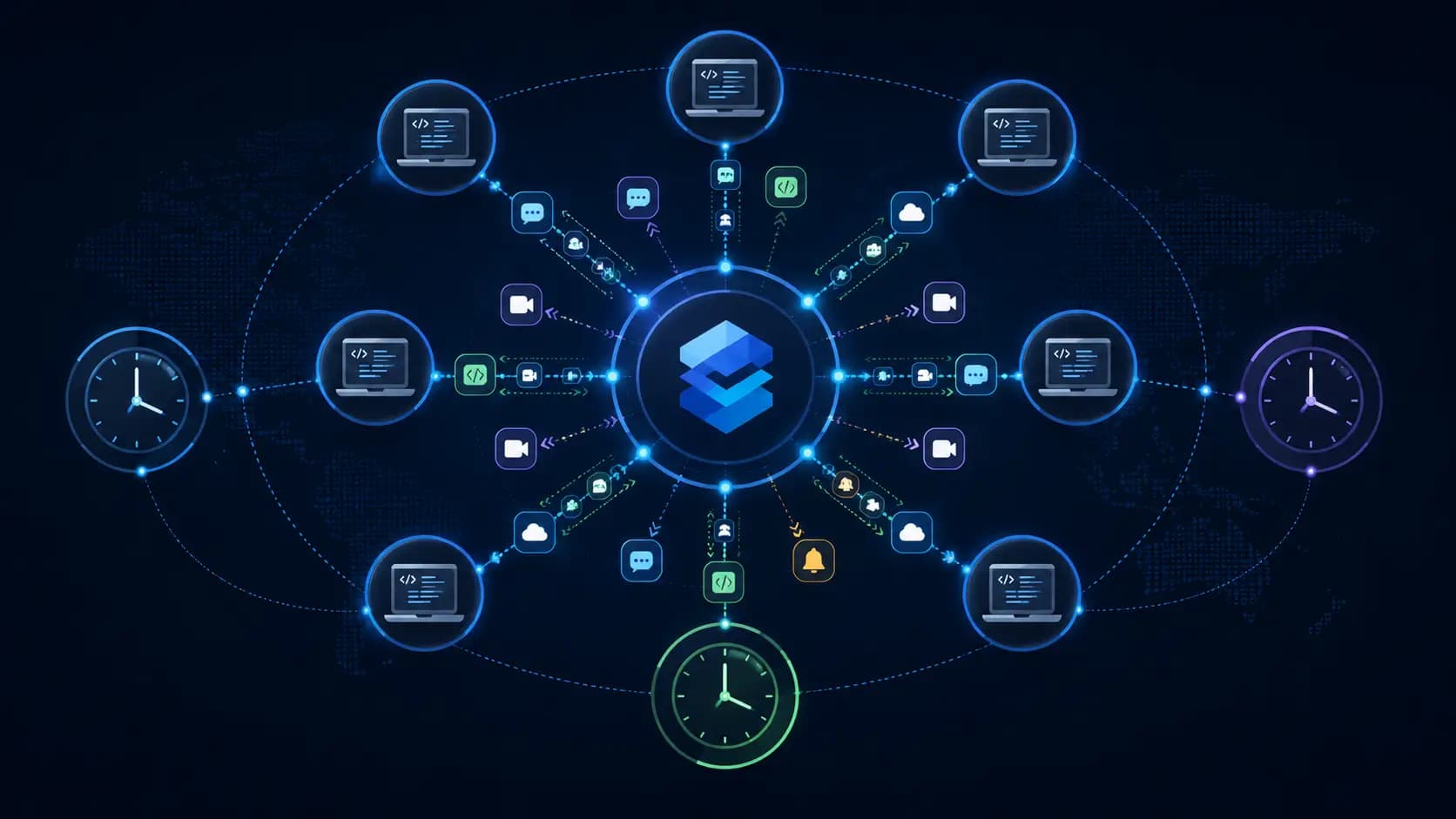
Most founders who struggle with remote development teams do not have a trust problem. They have a visibility problem. When you cannot see someone work, your brain fills the silence with doubt. You send a status-check message at 9am your time, which is 7:30pm their time, because you needed to feel like something was happening. The engineer answers it, loses their flow state, and delivers less that day than they would have if you had said nothing. The micromanagement loop is self-reinforcing and self-defeating. The way out is not to trust more blindly. It is to build structures that make output visible without requiring you to watch the work happen.
The communication stack that actually works
Remote engineering teams need two distinct communication layers, and founders who conflate them create friction in both. The first layer is asynchronous and written: daily updates, sprint notes, decisions, blockers, and context that anyone can read at any time. The second layer is synchronous and scheduled: sprint kickoffs, demos, architecture discussions, and anything that requires real-time back-and-forth. The mistake is using the synchronous layer for things that belong in the async layer. A Slack message asking "how is the API integration going?" is a synchronous interruption dressed as an async question. It demands an immediate response, even if the answer could have waited for the end-of-day update. Move status updates entirely to async. Reserve sync time for decisions and demos.
The specific async format that works: a short written update posted at the end of each engineer's working day. Three sections only: what was completed, what is in progress, and what is blocked. No essays, no justifications. If something is blocked, it gets escalated in the next scheduled sync, not in a flurry of messages.

The sprint rhythm that replaces surveillance
Weekly sprints with a defined rhythm are the single most effective tool for managing remote teams without micromanaging. The cadence we use: Monday kickoff call (30 minutes, sprint goals confirmed, dependencies identified), Wednesday async mid-sprint check (written, not a call, unless something is blocked), Friday demo (30 to 45 minutes, working software shown, not slides). The Friday demo is non-negotiable. It forces the team to have something working and demonstrable every week, which is far more useful than a progress report. It also gives you a natural weekly reset: if the demo is good, the week was productive. If the demo has nothing to show, the conversation is about what got in the way, not about whether anyone was working hard enough.
Sprints also give engineers clarity that a continuous backlog cannot. When the scope of a week is defined, engineers can make good decisions about trade-offs without asking for permission. When the scope is open-ended, every decision requires a check-in because no one knows what the priority is.
Output-based accountability, not hours-based accountability
You cannot track hours for a remote team without creating a surveillance culture that kills the engineers you most want to keep. Senior engineers especially will leave an engagement where they feel watched rather than trusted. The alternative is not absence of accountability. It is accountability tied to output rather than time. The question is never "did you work eight hours today?" It is "did the sprint goal move forward?" A well-scoped sprint makes this measurable. If the sprint goal was to complete the payment integration and the payment integration is done by Friday, the accountability question answers itself. If it is not done, the Friday demo surfaces that fact and the conversation is about why, not about where the engineer was on Tuesday afternoon.

The onboarding structure that sets the engagement up correctly
How the first two weeks of an engagement go determines how the next six months go. The onboarding structure should include: a codebase walkthrough on day one (two hours, recorded, shared as a reference), a documented development environment setup with every dependency and access credential listed explicitly, a written explanation of the existing architecture and the decisions behind it, and a first sprint that is deliberately scoped small enough to guarantee success. The first sprint is not about building features. It is about the engineer making their first commit, getting through the review process, seeing a deployment succeed, and establishing that the feedback loop works. Engineers who have a good first two weeks stay. Engineers who spend the first two weeks fighting environment issues and unclear expectations are already half-way out.
How to use the timezone gap productively
An India-based team working IST (GMT+5:30) naturally overlaps with US East Coast mornings from around 8am to 12pm EST. Most founders treat the rest of the day as dead time. The teams that use remote engineers most effectively treat the non-overlap hours as deep work time. The engineer works without interruption for six to seven hours, then the overlap window becomes a focused handoff: the engineer walks through what was done, raises any blockers, and gets decisions made for the next day's work. This structure means engineers are productive during their peak hours, and the overlap window has a clear purpose rather than being used for status checks that could have been an async update.
The signals that tell you the engagement is healthy
You do not need to watch engineers work to know whether the engagement is healthy. You need to know what to look for in the output. Healthy engagements: Friday demos consistently show working software, blockers are raised early rather than discovered at delivery, engineers push back on unrealistic scope rather than silently committing to it, pull request descriptions are detailed enough that you understand what changed and why. Unhealthy engagements: demos are repeatedly deferred, blockers appear for the first time on the day something was due, scope questions are answered with "yes" without any discussion, and the most recent commit dates in the repository are more than two days old mid-sprint. The repository does not lie. A team that is working is committing code. If you are not seeing regular commits, something is wrong and the Friday demo will surface it.
The thing micromanagement actually signals
Founders who micromanage remote teams usually do so because a previous engagement went wrong and no one told them until it was too late. The structures above are not about trust. They are about building a system where problems become visible early enough to fix them, which is what makes trust possible. A founder who can see the sprint board, read the end-of-day updates, and watch a live demo every Friday does not need to send status-check messages. They already know what is happening.
Written by

Founder & CEO
Gaurang Ghinaiya is the Founder & CEO of Nexios Technologies. He is passionate about building innovative software solutions that drive business growth. With years of experience in technology leadership, he guides teams toward excellence.