Engineering Post-Sale Customer Engagement: Retention Automation Without the Spam
Post-purchase sequences that convert are data-driven systems built on behavioral signals, purchase history, and product feedback loops, not emails written once and forgotten. This is the engineering behind retention systems that actually move the needle.
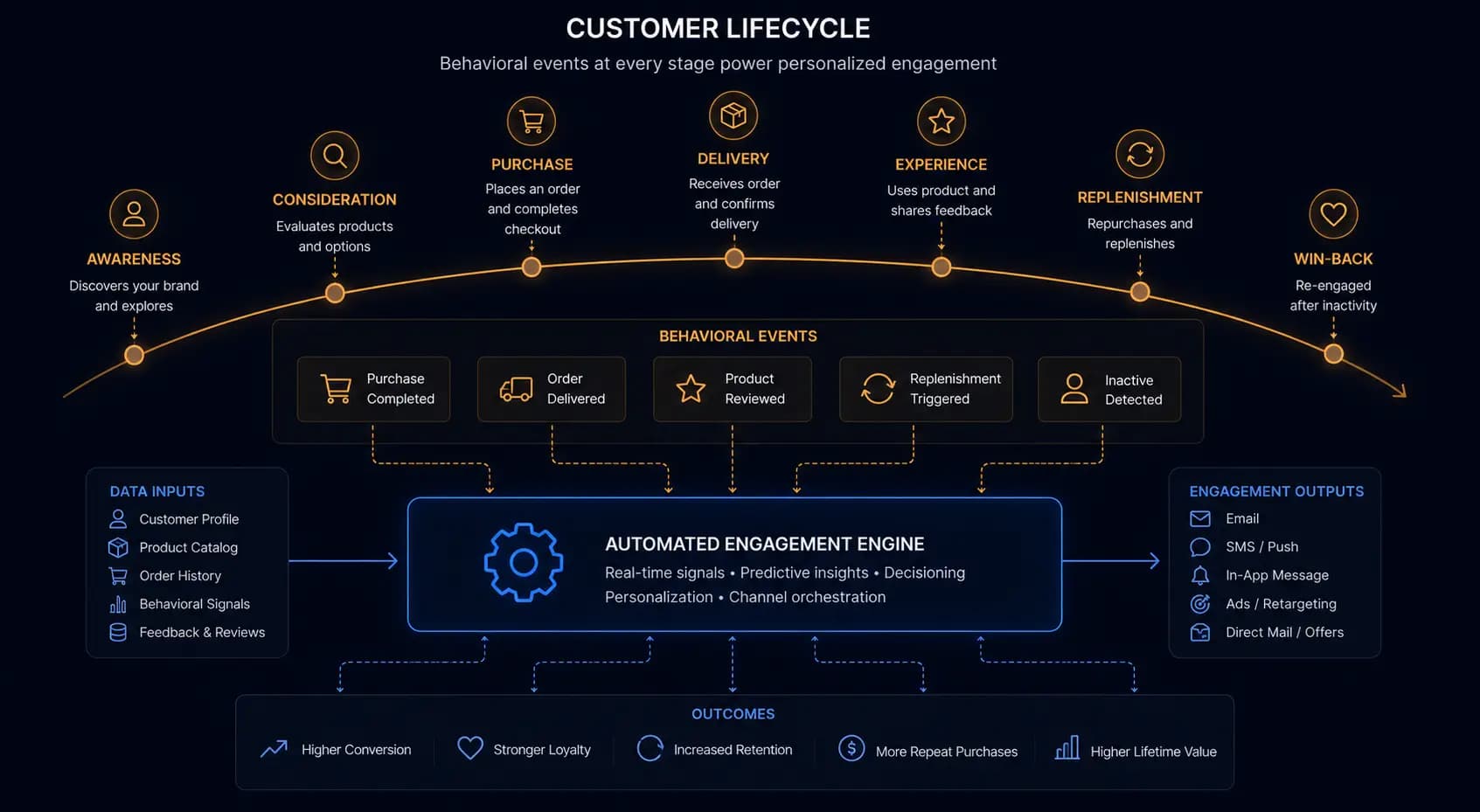
Most e-commerce brands treat post-sale customer engagement as a marketing problem: write better emails, find a better subject line, and test different send times. The brands that build real retention systems understand it is an engineering problem first: you need to model customer behavior, capture the right signals, and build the infrastructure to act on those signals in real time and at scale.
This post covers the engineering side of post-sale engagement, the data models, event pipelines, and automation logic behind retention systems that work.
The customer lifecycle model
Before building any engagement automation, you need a model of the customer lifecycle specific to your business. Generic lifecycle stages (new customer, active, at-risk, and churned) are starting points, but the thresholds that define each stage depend entirely on your purchase frequency distribution.
A customer buying pet food every 30 days who has not purchased in 45 days is probably at risk. A customer buying luxury furniture who has not purchased in 45 days is probably still actively engaged. The lifecycle model must be calibrated to your actual purchase frequency data.
Purchase frequency analysis
SELECT

  customer_tier,

  ROUND(AVG(days_between_purchases)) as avg_days,

  ROUND(PERCENTILE_CONT(0.5) WITHIN GROUP (ORDER BY days_between_purchases)) as median_days,

  ROUND(PERCENTILE_CONT(0.9) WITHIN GROUP (ORDER BY days_between_purchases)) as p90_days

FROM (

  SELECT

    c.id as customer_id,

    c.tier as customer_tier,

    DATEDIFF(o.created_at, LAG(o.created_at) OVER (PARTITION BY c.id ORDER BY o.created_at)) as days_between_purchases

  FROM orders o

  JOIN customers c ON o.customer_id = c.id

  WHERE o.status = 'completed'

    AND o.created_at >= DATE_SUB(NOW(), INTERVAL 2 YEAR)

) intervals

WHERE days_between_purchases IS NOT NULL

GROUP BY customer_tier
Run this quarterly and update your lifecycle stage thresholds based on the results. A customer is "at risk" when their time since last purchase exceeds the P90 inter-purchase interval for their segment. That definition will be different for your repeat apparel buyer than for your subscription supplement customer.
RFM scoring
RFM (Recency, Frequency, Monetary) is the foundational scoring model for customer engagement. It has survived 30 years of marketing analytics because it works.
WITH order_metrics AS (

  SELECT

    customer_id,

    MAX(created_at) as last_order_date,

    COUNT(*) as order_count,

    SUM(total_price) as total_spend,

    DATEDIFF(NOW(), MAX(created_at)) as days_since_last_order

  FROM orders

  WHERE status = 'completed'

  GROUP BY customer_id

)

SELECT

  customer_id,

  NTILE(5) OVER (ORDER BY days_since_last_order ASC) as r_score,

  NTILE(5) OVER (ORDER BY order_count DESC) as f_score,

  NTILE(5) OVER (ORDER BY total_spend DESC) as m_score

FROM order_metrics
Store these scores in a customer attributes table, updated nightly. Use them to drive segmentation for campaigns and to define lifecycle stage transitions.
The behavioral event pipeline
For post-sale engagement, the critical events to capture:
- order.completed: with line items, amounts, and fulfillment method
- order.shipped: with tracking info and estimated delivery
- order.delivered: confirmed from carrier webhook
- return.initiated: with return reason if collected
- review.submitted: with rating and text
- email.opened / email.clicked: per campaign
- product.viewed / product.added_to_cart: browsing signals
- support.ticket_created: with category
Events flow from multiple sources (storefront, OMS, shipping provider webhooks, and email provider) into a central event bus:
interface CustomerEvent {

  eventId: string        // UUID, for deduplication

  eventType: string

  customerId: string

  occurredAt: Date

  properties: Record

  source: string

}


async function publishEvent(event: CustomerEvent): Promise {

  await db.customerEvents.upsert({

    where: { eventId: event.eventId },

    create: event,

    update: {},   // idempotent, duplicate events are no-ops

  })

  await queue.add('process-customer-event', event)

}
The upsert with no-op update handles deduplication; shipping webhooks are notorious for sending the same event multiple times.

Engagement sequence automation
The highest-value post-purchase sequence for most e-commerce brands:
- Order confirmation: immediately on order.completed
- Shipment notification: on order.shipped, with tracking link and estimated delivery
- Delivery confirmation + review request: 2 days after order.delivered, ask for a review while the experience is fresh; this is the highest-converting review request timing in practice
- Product education: 7 days after delivery, content specific to the products purchased (usage tips, care instructions, and complementary recommendations by category)
- Replenishment reminder: for consumable products, at the predicted replenishment date (if a customer bought a 60-day supply, remind them at day 50)
- Win-back: if the customer has not purchased again by P90 inter-purchase interval for their segment, trigger a win-back sequence
Sequence engine
interface EngagementRule {

  id: string

  triggerEvent: string

  triggerCondition: (event: CustomerEvent, profile: CustomerProfile) => boolean

  delayMs: number

  template: string

  suppressIfEvent?: string  // suppress if customer does X before the message sends

}


// When an event fires, evaluate all matching rules

queue.process('process-customer-event', async (job) => {

  const event = job.data as CustomerEvent

  const profile = await getCustomerProfile(event.customerId)


  for (const rule of POST_PURCHASE_RULES) {

    if (rule.triggerEvent !== event.eventType) continue

    if (!rule.triggerCondition(event, profile)) continue


    await queue.add(

      'send-engagement-message',

      { ruleId: rule.id, customerId: event.customerId, eventId: event.eventId },

      { delay: rule.delayMs }

    )

  }

})


// At send time, check suppression

queue.process('send-engagement-message', async (job) => {

  const rule = POST_PURCHASE_RULES.find(r => r.id === job.data.ruleId)

  if (!rule) return


  if (rule.suppressIfEvent) {

    const suppressingEvent = await db.customerEvents.findFirst({

      where: {

        customerId: job.data.customerId,

        eventType: rule.suppressIfEvent,

        occurredAt: { gte: new Date(job.timestamp) },

      },

    })

    if (suppressingEvent) return  // suppressed

  }


  await emailProvider.send({ to: job.data.customerId, template: rule.template })

})
Personalization beyond name and order number
True personalization in post-sale emails comes from using behavioral data to make the content genuinely relevant. Build an affinity score for each customer × product category pair based on their purchase history and browsing behavior:
SELECT

  e.customer_id,

  c.name as category_name,

  COUNT(CASE WHEN e.event_type = 'order.completed' THEN 1 END) * 3.0 +

  COUNT(CASE WHEN e.event_type = 'product.added_to_cart' THEN 1 END) * 2.0 +

  COUNT(CASE WHEN e.event_type = 'product.viewed' THEN 1 END) * 0.5

  AS affinity_score

FROM customer_events e

JOIN products p ON (e.properties->>'$.product_id') = p.id

JOIN categories c ON p.category_id = c.id

WHERE e.occurred_at >= DATE_SUB(NOW(), INTERVAL 6 MONTH)

GROUP BY e.customer_id, c.name
A customer who has bought running shoes twice and viewed hiking boots twice gets outdoor footwear recommendations in their post-purchase email, not your current promotion on kitchenware.
Win-back timing intelligence
The standard win-back strategy sends a discount at a fixed interval. The smarter strategy sends the win-back at the predicted purchase date based on that customer's specific purchase pattern, with the offer size calibrated to the customer's predicted lifetime value.
async function scheduleWinBack(customerId: string): Promise {

  const profile = await getCustomerProfile(customerId)

  const segmentThreshold = await getSegmentPurchaseThreshold(profile.segment)


  if (profile.daysSinceLastOrder < segmentThreshold) return  // not yet at-risk


  const predictedNextPurchase = await predictNextPurchaseDate(customerId)

  const ltv = await predictCustomerLTV(customerId)


  const offerTier = ltv > 500 ? 'high-value' : ltv > 200 ? 'mid-value' : 'standard'

  const winBackDelay = Math.max(0, predictedNextPurchase.getTime() - Date.now())


  await queue.add('send-winback', { customerId, offerTier }, { delay: winBackDelay })

}
The metrics that matter
- Repeat purchase rate: % of customers who make a second purchase within 90 days of first purchase. This is the most important cohort metric for e-commerce retention.
- Time to second purchase: how quickly first-time buyers convert to repeat buyers. Correlates strongly with LTV.
- Win-back rate: % of at-risk customers who purchase again within 60 days of receiving a win-back sequence.
- Review submission rate by trigger: which timing and message generates the most reviews.
- Revenue per engaged customer: customers who receive and interact with your post-purchase sequences versus those who do not. This is your ROI justification for the engineering investment.
Post-sale engagement systems built this way, on behavioral signals, calibrated to your specific customer patterns, with suppression logic that prevents over-messaging, routinely outperform generic email sequences by 3 to 5x on repeat purchase metrics. The engineering investment is significant, but the ROI in customer lifetime value is direct and measurable.
Written by

Founder & CEO
Gaurang Ghinaiya is the Founder & CEO of Nexios Technologies. He is passionate about building innovative software solutions that drive business growth. With years of experience in technology leadership, he guides teams toward excellence.