Home health agencies were coordinating care across Microsoft Teams, email, and phone calls: none of which understand the clinical context of home health. When a patient is discharged from hospital (an ADT event), when an IDG meeting is scheduled, when a coordination note needs to reach a clinician in the field: none of these workflows had a purpose-built communication layer. Generic communication tools do not know what an episode is. They do not understand the difference between an ADT admission feed and an MDM message. Building on top of them meant building around them, perpetual workarounds instead of real integration.
- Clinicians wasting 12–15 minutes daily hunting for clinical context across disconnected tools
- Admin staff spending 18–25 minutes on manual coordination tasks that should have been automated
- No bidirectional integration with HCHB: the largest home health EMR in the US
- ADT events, IDG meetings, and coordination notes handled through generic messaging tools
- Avoidable hospital readmissions from coordination gaps costing agencies significantly
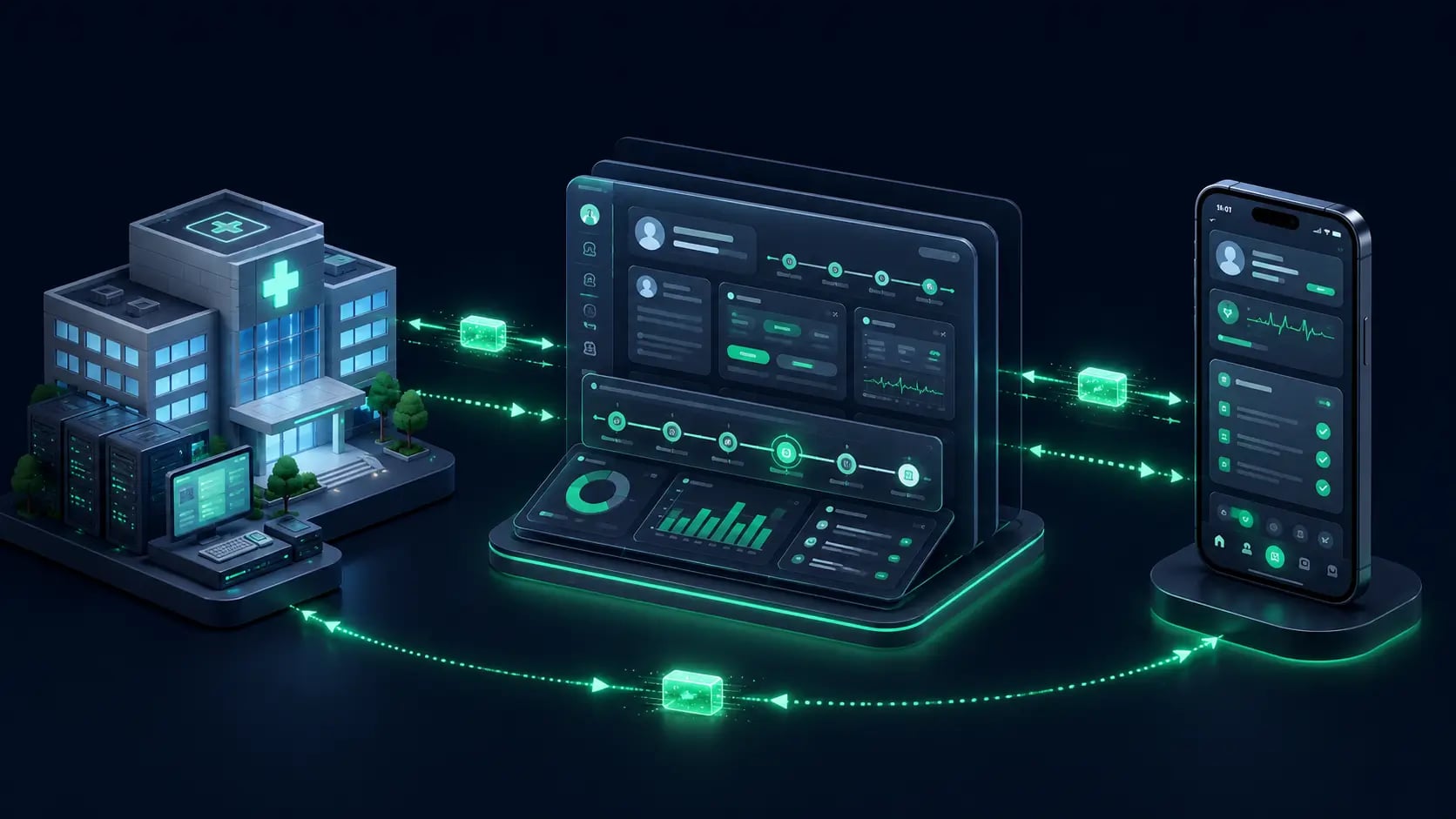
- ADT feed integration: automatic patient intake on admission, transfer, or discharge
- MDM attachment sync: clinical documents flow between the platform and HCHB without manual re-entry
- Coordination notes: structured notes tied to patient episodes, visible to the full care team in real time
- IDG meeting support: interdisciplinary group coordination built into the workflow
- Native iOS (Swift) and Android (Kotlin) apps for field clinicians
- Real-time bidirectional sync: changes in HCHB surface in the platform instantly
We chose native iOS and Android over a cross-platform framework because home health clinicians work in low-connectivity environments: patient homes, rural routes, hospital elevator shafts. A React Native or Flutter abstraction layer would have put a wall between the app and the device's network stack that we could not afford. Swift and Kotlin gave us direct control over offline queuing, background sync, and push notification delivery. In a clinical setting, those are not performance niceties. They are the difference between a nurse receiving a patient discharge alert in the car and receiving it the following morning.
ROI on platform investment
Clinician time saved daily
Admin time saved daily
Reduction in hospital & ER visits
The platform replaced a patchwork of generic tools with a single coordination layer that understands home health workflows natively.
“The Nexios team understood the clinical side from the start. They did not need us to explain what an IDG meeting was or why ADT events matter. The platform they built feels like it was designed by people who have spent time inside a home health agency, not just engineers who can write good code.”
Clinicians spend less time on administrative tasks and more time with patients. The bidirectional HCHB integration means the EMR and the coordination platform are always in sync: no manual reconciliation, no data entry duplication.
The most consequential decision in this project was not a technology choice. It was the scope of the first HCHB integration. We could have built a one-way read-only sync and shipped three weeks earlier. The client pushed for true bidirectionality from day one, and they were right. Read-only integrations in healthcare create two sources of truth. Once data diverges between an EMR and a coordination tool, no amount of training or process fully compensates. We carry that principle into every healthcare integration we scope: bidirectional sync is harder to build, but it eliminates an entire class of clinical risk that one-way sync can only delay.