
Intellectual property theft is invisible until it is too late. Traditional IP protection (patents, trademarks, copyright registration) is expensive, slow, and often overkill for everyday creative work. A freelance designer does not need a patent, they need a fast, affordable way to prove their design existed on a specific date before anyone else claimed it.
- No verifiable timestamp proving origination: just emails, screenshots, and "my word against yours"
- Patent and trademark registration takes months and costs thousands
- Screenshots and email trails are easily contested and not legally robust
- No affordable tool for everyday creators to prove prior art quickly
- Generic cloud storage timestamps are alterable and not independently verifiable
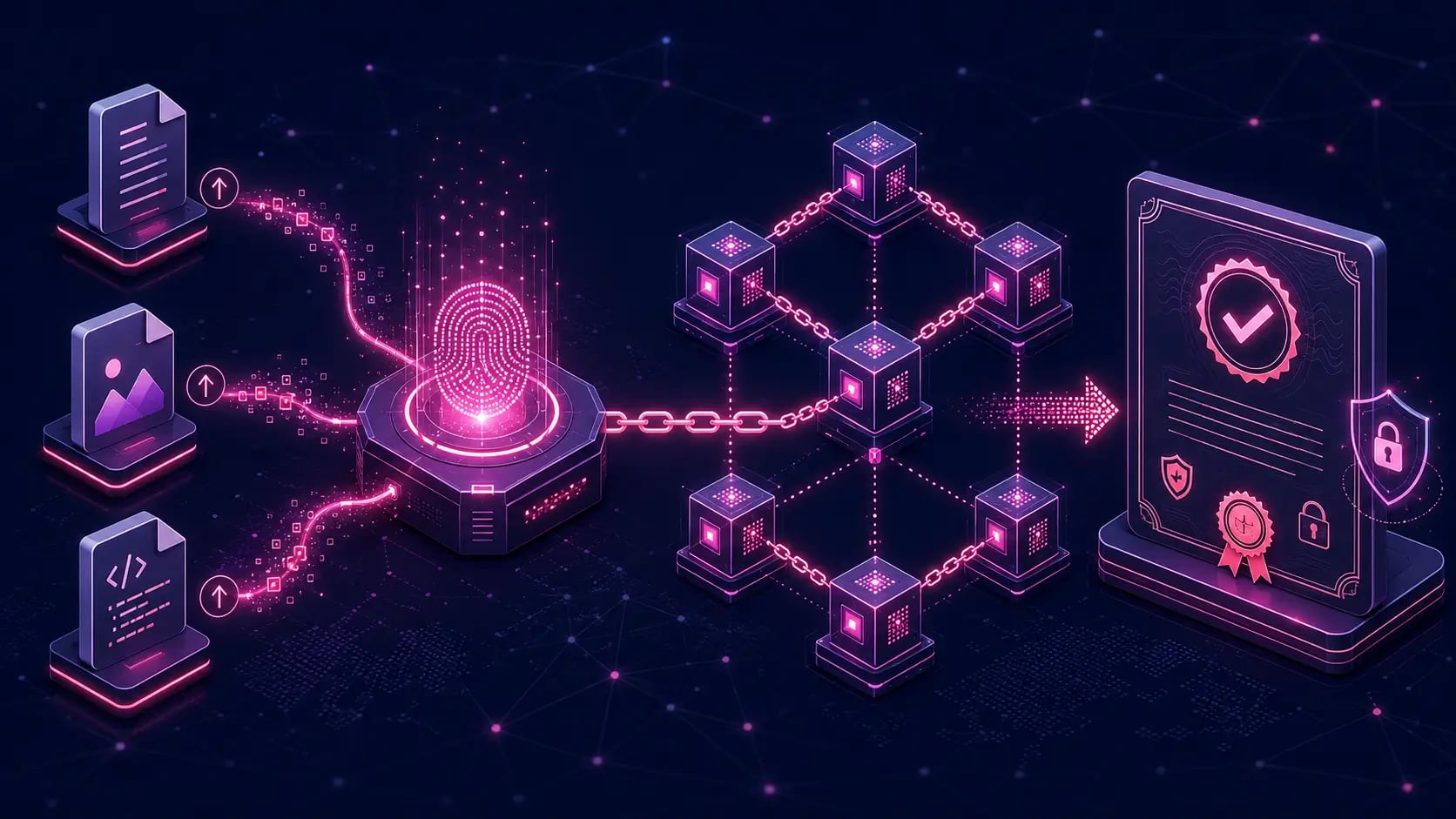
- Cryptographic hash of the uploaded file written permanently to the blockchain
- Signed digital certificate issued with timestamp and hash: verifiable by any third party
- File-agnostic: protects documents, images, designs, code, videos, contracts
- Certificate dashboard: manage all protected assets in one place
- Shareable verification link: send to clients, courts, or collaborators
- No central authority required: the blockchain record is independently verifiable
A question we addressed early in the design: why write only the cryptographic hash to the blockchain rather than the file itself? Because the blockchain is not a storage layer. It is a timestamping and verification layer. Storing the file itself on-chain would make every certificate prohibitively expensive in gas fees and would expose potentially sensitive documents to a permanent public ledger. Storing the hash costs a fraction of the gas and reveals nothing about the file's contents: a third party can verify that the exact file existed at the exact timestamp without ever seeing the file. The verification flow reflects this: to check a certificate, you re-hash the file and compare it to the on-chain record. If the hashes match, the blockchain timestamp proves the file existed at that moment. No central authority, no modifiable database, no way to backdate a claim.
Instant certificate issuance in seconds vs. weeks for traditional IP protection. Tamper-proof record that holds up in dispute resolution.
Proofit makes IP protection accessible to anyone who creates. The blockchain record means no central authority can be pressured or hacked to alter the evidence. The proof exists independently and permanently.
Building Proofit clarified something about what blockchains are actually useful for. They are not useful as general-purpose databases. They are slow, expensive, and immutable to the point of being unforgiving about errors. But they are exceptionally good at one specific thing: proving that a piece of data existed at a specific point in time, without requiring trust in any institution. That is a genuinely narrow use case, but it is exactly the use case IP certification needs. The lesson we carry: evaluate blockchain for the one problem it is uniquely suited to solve (trustless timestamping) and do not use it as a substitute for a database or a workflow engine.
View live project