Running a luxury watch and jewellery business involves more complexity than typical retail. New stock alongside pre-owned and mint-condition pieces, repair workflows, staff commission tracking, and dual online/in-store channels, generic CRMs like Salesforce or HubSpot were built for B2B sales pipelines, not for a retail operation where the "deal" is a physical object with a serial number, a service history, and a chain of custody.
- Dual inventory: new, pre-owned, and mint-condition pieces each with different sourcing and pricing
- Repair workflow tracked manually: job cards lost, customers uninformed on status
- Staff sales attribution messy or manual: commission tracking unreliable
- Online and in-store orders had no unified view
- Pre-owned buying intake (condition grading, pricing, provenance) was unsystematized
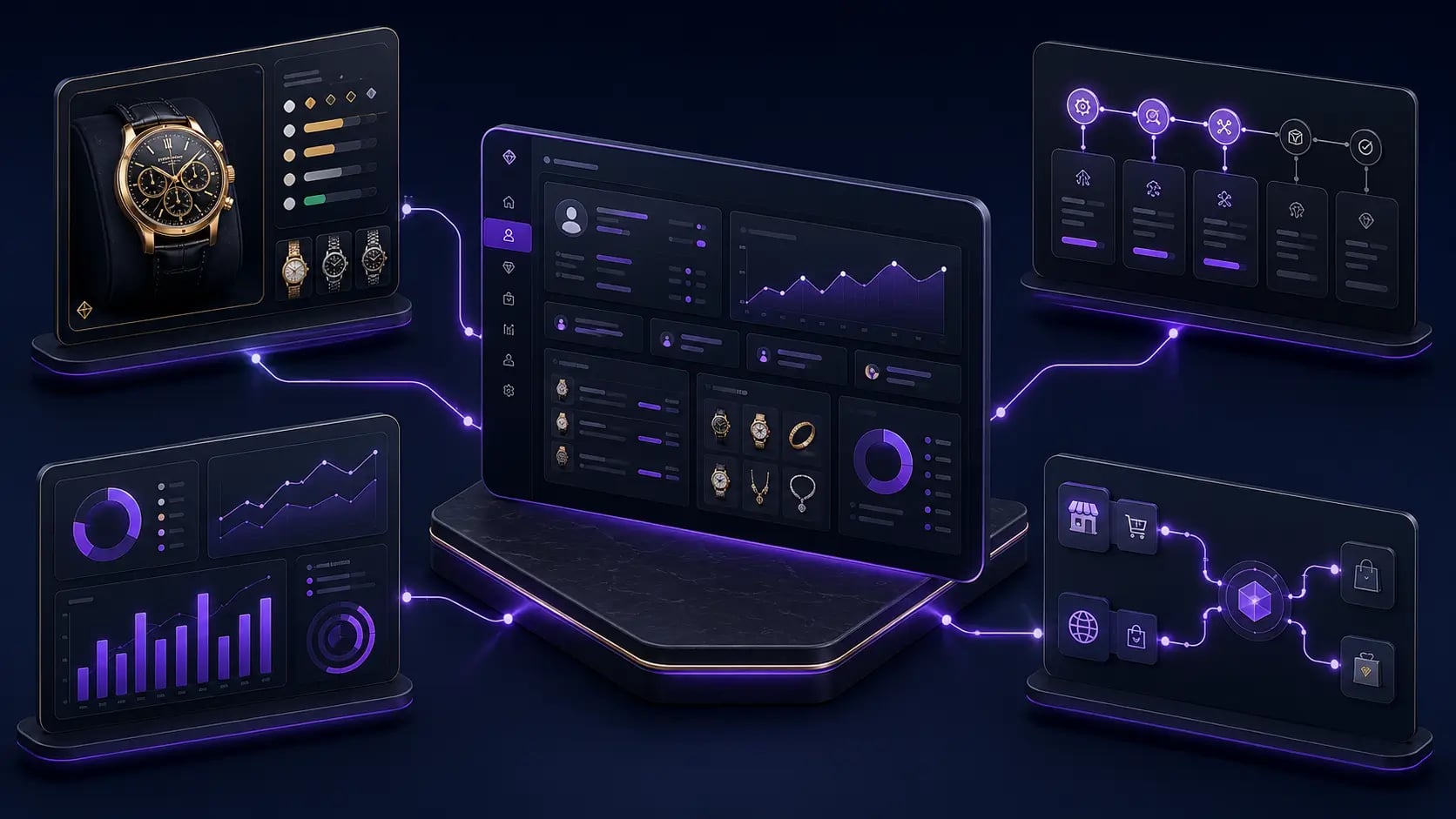
- Inventory management: separate handling for new, pre-owned, and mint-condition stock with serial number tracking
- Unified order management: in-store and online orders in a single view
- Repair workflow: stage-by-stage tracking from intake to collection with customer notifications
- Staff performance: sales attribution per staff member with commission calculation support
- Customer profiles: purchase history, preferences, watch wishlist, high-value customer flagging
- Pre-owned intake: condition grading, provenance tracking, purchase history per piece
The central architectural decision was to build a purpose-specific system rather than configure a generic CRM. The client had evaluated Salesforce and HubSpot before approaching us. Both platforms are built for B2B sales pipelines where the 'product' is a service and the 'deal' is a relationship. A luxury watch with a serial number, a service history, authentication papers, and a chain of custody is not a deal. It is a physical object with a life story. Generic CRM data models cannot represent this without extreme customisation that ends up costing more than a bespoke build and produces a worse result. Laravel and MySQL gave us a clean schema that reflected how the business actually thinks about its inventory: new, pre-owned, and mint-condition are not tags on a product. They are fundamentally different workflows with different intake processes, pricing logic, and margin structures.
Revenue growth since implementation
In-store + online inventory
End-to-end repair tracking
Staff attribution replacing manual tracking
The CRM replaced a mix of spreadsheets, generic software, and tribal knowledge with a single system built around how a luxury watch retailer actually operates.
“Before this CRM, we were running the business on spreadsheets and memory. Staff attribution was basically whoever wrote it down first. Now we have a real-time view of every piece of inventory, every repair job, every sale. The 30% growth since we went live is not a coincidence.”
The 30% YOY growth since implementation reflects what happens when a business can see everything clearly: inventory, repairs, staff performance, customer relationships, all in one place with no reconciliation between systems.
The repair workflow module took longer to build than any other part of the system, and it was the most important. Repair jobs in a luxury watch context are high-stakes: a £15,000 Rolex in for a service means a customer is trusting you with something irreplaceable. The status notifications, the stage-by-stage tracking, the customer communication at each milestone. These were not features the client initially prioritised in the brief. They emerged from a workshop where we asked: what is the single interaction that most damages a luxury retailer's reputation? The answer was universal: a customer calling to ask where their watch is and nobody in the shop knowing. Every hour we spent on repair workflow was justified by that answer.