EMR/EHR Integration for Digital Health Startups: The Practical Guide
Every digital health product eventually has to talk to an EMR. This is the practical guide: which integration path fits your stage, what each vendor actually requires, and where the timeline risk hides.
Every digital health product reaches the same milestone: a prospect says "this looks great, does it integrate with our EMR?" and the honest answer determines whether the deal happens. EMR integration is the moat and the tax of healthcare software. This guide covers the integration paths available to a startup, what each major vendor actually requires, and where the timeline risk hides.
The three integration paths
There are three ways to exchange data with an EMR, and they differ by an order of magnitude in effort and access.
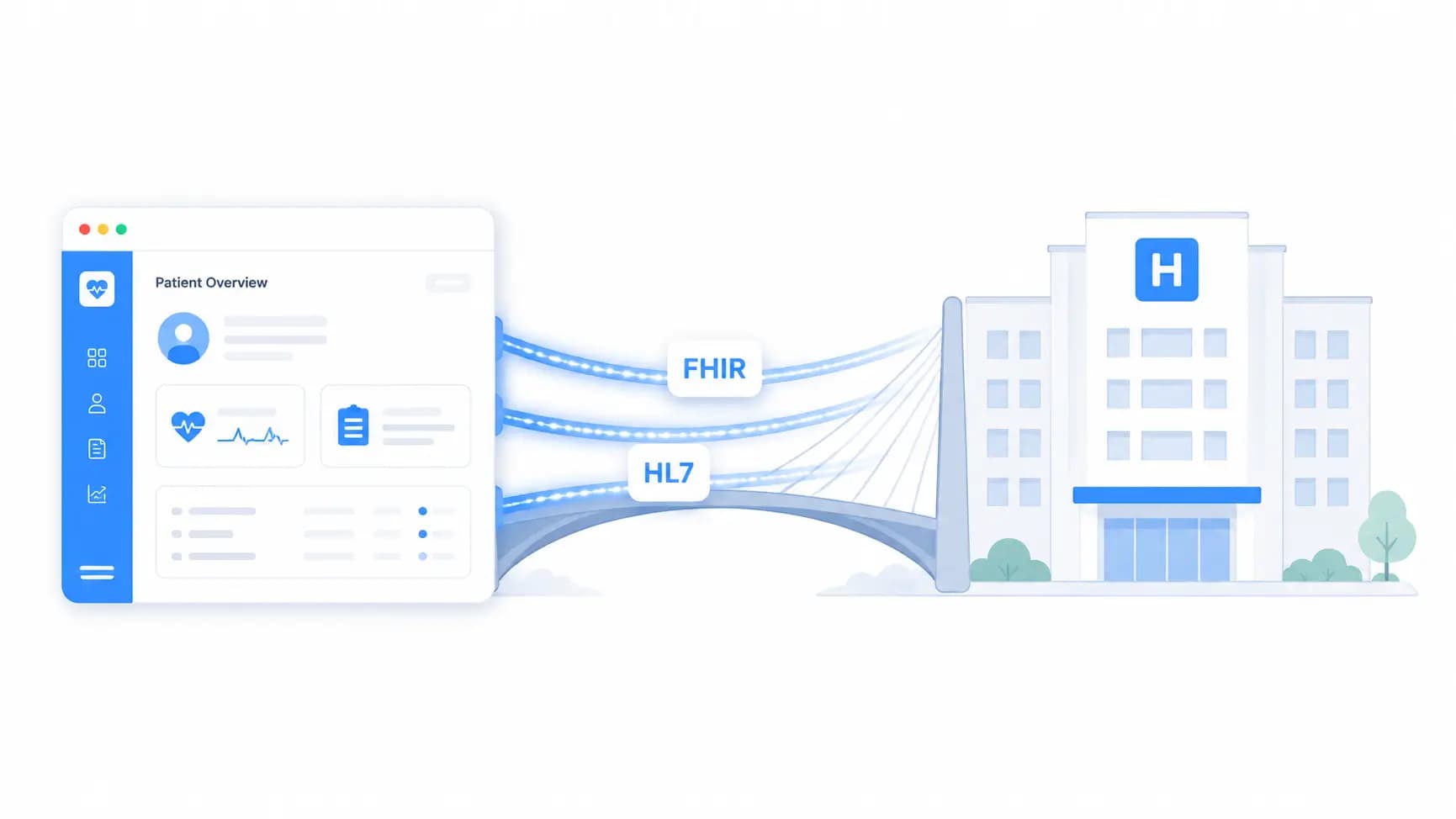
- Vendor FHIR APIs. Epic, Oracle Health (Cerner), Athenahealth, and most modern EMRs expose FHIR R4 endpoints, partly because US regulation (the Cures Act) requires patient-access APIs. Scope varies: patient-access APIs are broad, but the system-level scopes a B2B product needs (reading schedules, writing notes) are gated behind vendor programs.
- HL7 v2 interfaces. The workhorse of hospital integration: ADT feeds for admissions and demographics, SIU for scheduling, ORU for results. Delivered over VPN or through an interface engine. Older, uglier, and often the only way to get real-time event flow. When to use which is the subject of our HL7 FHIR vs HL7 v2 guide.
- Integration platforms. Redox, Health Gorilla, and similar networks sell one API that fans out to many EMRs. You trade per-connection engineering for a per-message or per-connection fee, and you inherit their vendor coverage instead of building your own.
 Three paths into the EMR. Most products end up using at least two.
What the major vendors actually require
The public story is "we have open APIs." The operational story has more steps.
Epic. Self-service sandbox access is genuinely good: open.epic.com gives you FHIR documentation and test endpoints the same day. Production is different: your app goes through Epic's vendor services review, and each health system decides individually whether to turn you on. Budget weeks for the review and per-site conversations after it.
Oracle Health (Cerner). Similar shape: free sandbox, code console registration, then per-site activation. System-level scopes require the health system's approval, and the approval conversation goes better when a customer champion requests it.
Athenahealth, eClinicalWorks, and ambulatory EMRs. Marketplace programs with revenue share (commonly 10-30% of your contract value for deals sourced through their marketplace). Read the partnership terms before you architect around them.
Specialty EMRs. Home health (Homecare Homebase, Axxess), behavioral health, dental: many have no public API program at all. Integration happens through flat-file exchange, direct database agreements, or negotiated interfaces. Our HCHB integration writeup shows what a production integration with a closed specialty EMR takes.
The timeline nobody quotes
Engineering is rarely the long pole. A realistic first-integration timeline for a B2B clinical product:
| Phase | Typical duration | What controls it |
|---|---|---|
| Sandbox build | 2-4 weeks | Your team |
| Vendor program review | 2-8 weeks | The vendor |
| Health system security review | 2-12 weeks | The customer's IT and security office |
| Site activation and testing | 2-6 weeks | Both, plus the interface team's queue |
The security review is the wildcard: a SOC 2 report, a completed BAA, and clean answers on the technical safeguards can compress it from months to weeks. Showing up without them adds a quarter.
Architecture decisions that age well
- Normalize at the boundary. Map every inbound payload, FHIR or v2, into your own internal model at the edge. Your product logic should never know which EMR the data came from.
- Design for partial data. Every site sends a different subset of fields. Feature-flag on data availability per connection, not per customer tier.
- Queue everything inbound. ADT feeds burst; FHIR bulk exports arrive as files. An ingestion queue with per-connection replay saves you when a mapping bug needs reprocessing.
- Track provenance. Store where each field came from and when. Clinical users will ask "why does it say this," and support needs the answer.
 Normalize at the edge: product code sees one model, never the source EMR's dialect.
Build, buy, or platform
The decision is mostly about deal flow. If your next ten customers are on three EMRs, direct integrations are cheaper and give you better data. If your pipeline spans fifteen EMRs, a platform buys coverage you cannot build in time, at a fee that compounds with volume. Most companies we work with land on a hybrid: direct connections to their top two vendors, a platform for the long tail.
Integration capability is a product asset, not plumbing. The teams that treat it that way, with owned mappings, monitored feeds, and a repeatable activation playbook, close enterprise healthcare deals that competitors cannot. If you are planning your first EMR integration or replacing a platform dependency with direct connections, our healthcare engineering team has done both and can help you sequence it.
Written by

Founder & CEO
Gaurang Ghinaiya is the Founder & CEO of Nexios Technologies. He is passionate about building innovative software solutions that drive business growth. With years of experience in technology leadership, he guides teams toward excellence.