The Engineer's Guide to HIPAA Business Associate Agreements
A BAA is a legal document with engineering consequences. Which vendors in your stack need one, what you just promised technically, and how to audit the chain.
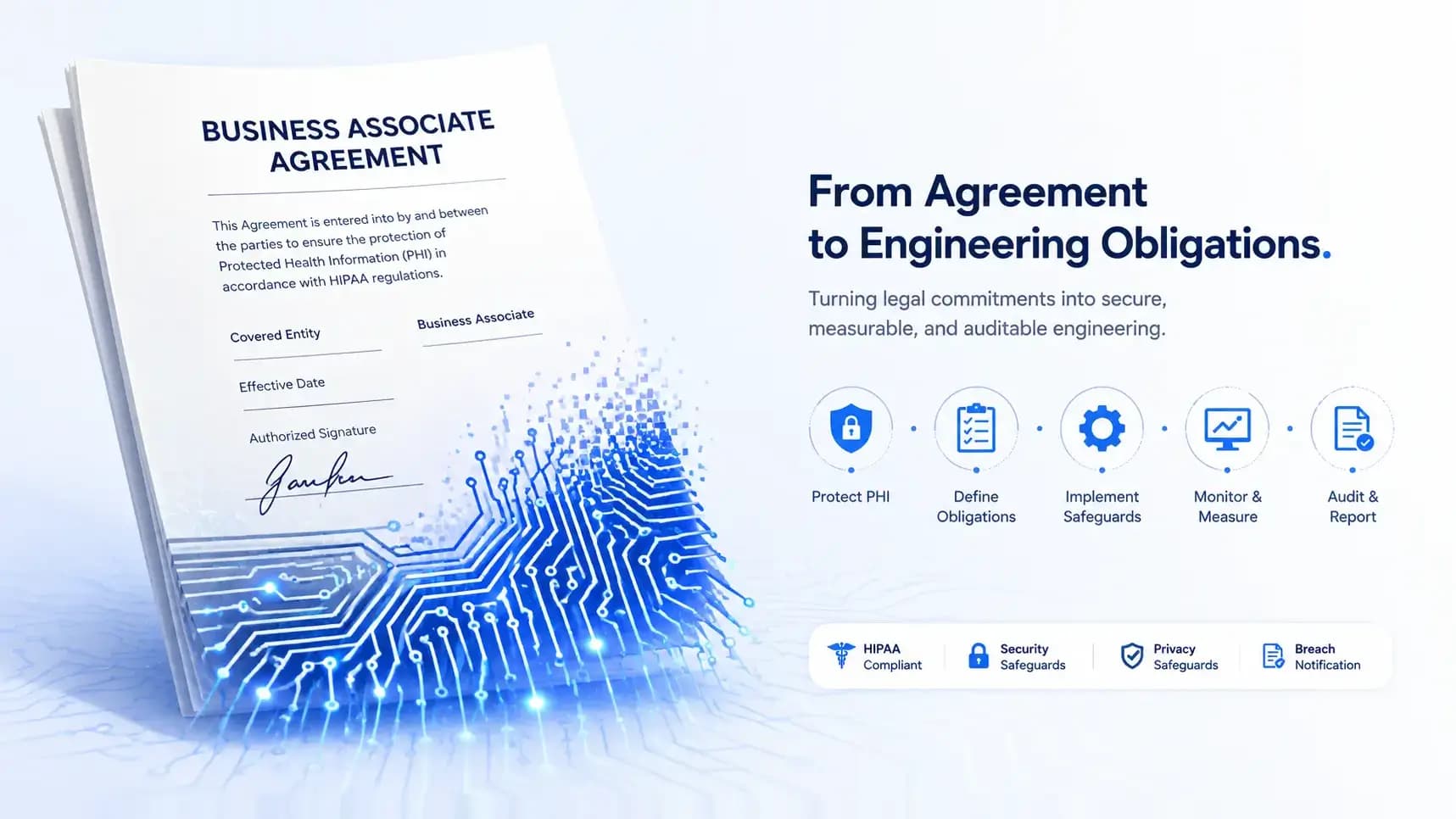
A Business Associate Agreement reads like legal boilerplate, but every clause maps to an engineering obligation. Sign one without reading it as a technical spec and you have promised capabilities your system may not have: breach detection within a deadline, data return on termination, subcontractor flow-down. This is the BAA guide for the people who have to make the promises true.
Who needs one
The chain is simple in principle: covered entities (providers, payers, clearinghouses) sign BAAs with business associates (you, if you create, receive, maintain, or transmit PHI on their behalf), and business associates sign BAAs with their subcontractors that touch PHI. In practice the interesting question is which of your vendors are in the chain:
- Need a BAA: cloud infrastructure (AWS, GCP, Azure), managed databases, email and SMS providers that carry PHI content, video platforms for telehealth, transcription and AI services processing clinical content, error trackers that might capture PHI, support desks where PHI appears in tickets.
- Do not need one: services genuinely outside the PHI path: your CI provider, your marketing site host, analytics that never receive PHI (because you engineered it that way), payment processors handling only payment data (PCI, not PHI).
- The trap category: tools that were outside the PHI path until someone pasted a patient record into them. Slack, Notion, ChatGPT. Policy plus DLP tooling keeps them out; a BAA (where offered) makes them safe to bring in.
 The BAA chain flows down. Every subcontractor touching PHI needs its own agreement.
Reading a BAA as an engineering spec
The recurring clauses and what they actually require from your system:
| Clause | Engineering obligation |
|---|---|
| Safeguards "as required by the Security Rule" | The full technical safeguards set: access control, encryption, audit logging, integrity controls |
| Breach notification within N days (often 5-10, sometimes 72 hours) | Detection capability: alerting on anomalous PHI access, an incident runbook, and logs good enough to scope what was accessed, which is what our audit log schema exists for |
| Minimum necessary | Role-scoped access in the product and in your internal tooling; support staff do not get database-wide read |
| Return or destruction on termination | A tested data export per customer, and deletion that actually reaches backups and derived stores within a stated window |
| Subcontractor flow-down | A vendor inventory mapping every PHI-touching service to a signed BAA, reviewed when engineering adds a dependency |
| Right to audit | Evidence on demand: policies, access reviews, training records, and the ability to demonstrate controls, which is where a SOC 2 saves weeks |
Cloud BAAs cover services, not architectures
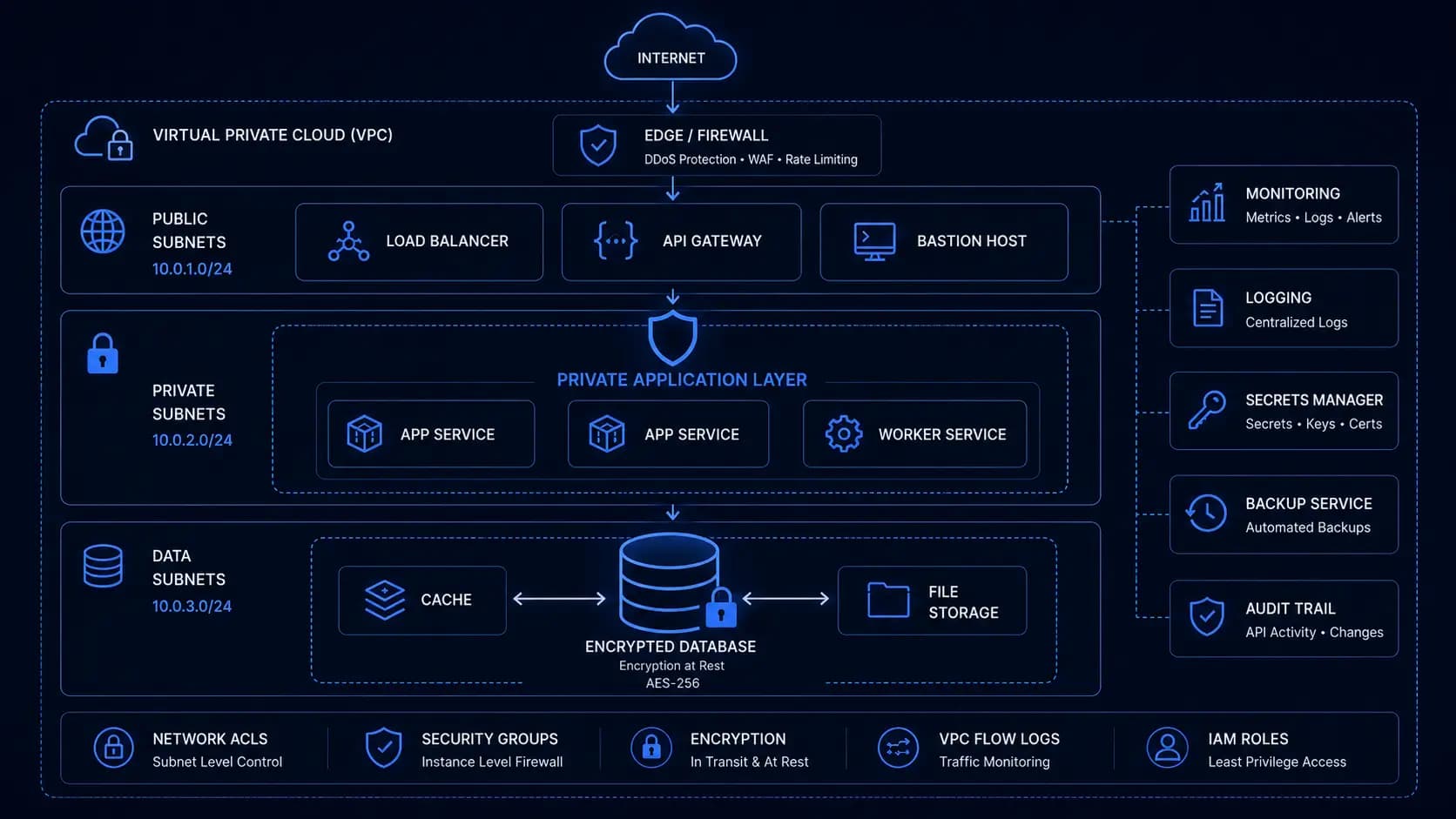
AWS will sign a BAA, but it applies only to HIPAA-eligible services, and it does not make your architecture compliant. Using an eligible service in an ineligible way (PHI in a service outside the eligible list, unencrypted PHI in S3, public snapshots) is your breach, not Amazon's. The reference layout that keeps the promise true is our HIPAA-compliant AWS infrastructure post. The same logic applies to AI vendors: OpenAI, Anthropic, and Google all offer BAA-covered tiers now, but only on specific products and endpoints, and default consumer tiers are never covered.
The vendor inventory is the living artifact
The BAA work that fails audits is rarely the signature; it is the drift afterward. An engineer adds a transcription API in a sprint, PHI starts flowing, and nobody signed anything. The control that works is boring and effective:
- A single inventory: vendor, what PHI it touches, BAA status, date, owner.
- A checklist gate in engineering: any new external service answers "does this touch PHI?" before it ships. Dependency reviews and infrastructure-as-code make the gate enforceable.
- An annual re-review, because vendors change their products and your usage changes shape.
 The gate that prevents drift: no new PHI-touching dependency without an inventory entry.
When a customer sends you their BAA
Enterprise health systems send their own paper, and it is negotiable more often than teams assume. The clauses worth pushing back on: breach notification windows shorter than your detection capability (do not sign 24 hours if your alerting cannot deliver it), audit rights without notice periods, and indemnification far beyond your insurance. Sign what your system can honor; the BAA you cannot operationalize is worse than a slow deal, because it converts an incident into a contract breach.
We build products that live inside these agreements every day, from HIPAA-compliant development practices through infrastructure and audit evidence. If your team is staring at a health system's BAA wondering what you are about to promise, our HIPAA compliance engineering practice can review the technical clauses and close the gaps before you sign.
Written by

Founder & CEO
Gaurang Ghinaiya is the Founder & CEO of Nexios Technologies. He is passionate about building innovative software solutions that drive business growth. With years of experience in technology leadership, he guides teams toward excellence.