Legacy System Modernization: The Strangler Pattern in Practice
Big-bang rewrites fail on contact with reality. Strangler pattern mechanics, finding seams in a monolith, and migrating data without a weekend outage.

Every big-bang rewrite starts with the same sentence ("the new system will have feature parity in nine months") and most end the same way: eighteen months in, the old system still runs the business, the new one covers 60% of the edge cases nobody documented, and the team is maintaining both. The strangler fig pattern exists because incremental replacement is the only modernization strategy with a survivable failure mode. This guide covers how it actually works in practice.
Rewrite vs refactor vs strangle: the honest math
- Refactor in place when the architecture is salvageable and the pain is code quality: cheapest, lowest risk, and undersold because it is unglamorous.
- Full rewrite only when the platform itself is dead (unsupported runtime, unhirable stack) and the system is small enough to hold in a few heads. Rewrites fail in proportion to the undocumented behavior they must reproduce, and legacy systems are mostly undocumented behavior.
- Strangler pattern for everything in between: new code grows around the old system, taking over one capability at a time, until the old system quietly has nothing left to do.
The strangler's real advantage is not technical elegance; it is that value ships continuously and the program can pause at any phase without leaving the business on a half-built bridge.
Step one: put a front door on the monolith
The pattern requires an interception point: a facade (API gateway, reverse proxy, or an application-level routing layer) that all traffic flows through, so requests can be routed per capability to old or new. Getting this seam in place is unexciting and is the whole ballgame: once routing is per-capability, migration becomes a sequence of small, reversible cutover decisions instead of one large bet. Route by capability, keep a per-route kill switch back to legacy, and log which system served what, because the first weeks of any cutover are a comparison exercise.
Finding seams: migrate capabilities, not code
The unit of migration is a business capability (notifications, pricing, document generation, reporting), not a code module. Good first candidates score high on three axes: loosely coupled to the core data model, painful enough that improvement is visible, and low blast radius when something goes wrong. Notification sending is the classic opener; the order pipeline is the classic finale. Map capabilities by their data coupling first, because the order of migration is really the order in which you can untangle who owns which tables.
Data is the hard part, so treat it as the main event
Code migration is logistics; data migration is risk. The patterns that keep it survivable:
- One writer per table at a time. Shared writes between old and new systems create conflicts no reconciliation job untangles. Each capability cutover transfers write ownership explicitly; reads can be shared during transition.
- Dual-write windows with reconciliation: when a capability moves, write to both stores for a bounded period, with an automated diff job reporting divergence. The diff report, not the calendar, decides when dual-writing ends.
- Parallel run for the scary cutovers: route real traffic to both systems, serve from legacy, compare outputs (the pricing engine, the payroll calculation). Weeks of silent agreement buy the confidence a test suite for undocumented behavior never can.
- Backfill with idempotent, resumable jobs: historical migration always finds data the schema says cannot exist. Jobs that checkpoint and re-run beat weekend-outage migrations every time.
Program discipline: the freeze and the ledger
Two management rules decide whether the program converges. First, a feature freeze on migrated capabilities in the legacy system: new work on a capability lands in the new home or waits; otherwise you are chasing a moving target. Second, a visible ledger of what has moved, what is dual-running, and what remains, reviewed monthly against the original case. Modernization programs die of quiet scope growth and invisible progress; the ledger is the antidote to both. Staffing follows the same logic: the team needs people who read the old system fluently, not just people excited about the new one, which is where augmenting the team with engineers who have done this before changes the slope, and where the collaboration patterns from our remote team management guide keep a split legacy/new team coherent.
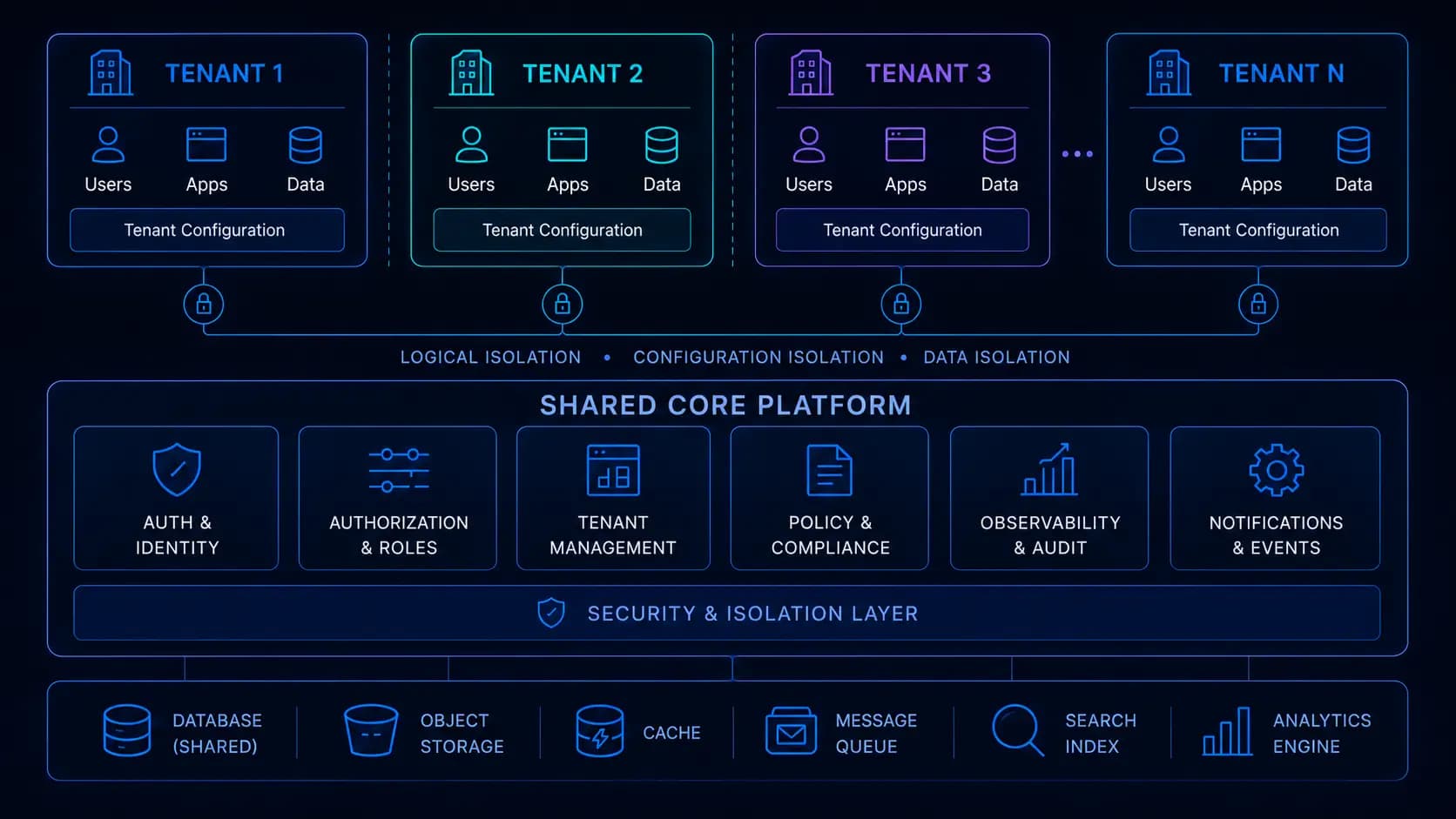
On the destination side, resist re-architecting into fashion: the goal is a system your team can operate, usually a well-boundaried monolith or a handful of services, with the tenancy and API contracts done properly, per our multi-tenant architecture and API design guides. Microservices are not a modernization outcome; they are a topology some teams need.
Legacy systems are load-bearing precisely because they encode twenty years of decisions nobody wrote down. If yours is due for replacement and the rewrite quotes keep getting scarier, our engineering team runs strangler programs with the facade, data patterns, and ledger discipline described here, value shipping from the first quarter, not after the last one.
Written by

Founder & CEO
Gaurang Ghinaiya is the Founder & CEO of Nexios Technologies. He is passionate about building innovative software solutions that drive business growth. With years of experience in technology leadership, he guides teams toward excellence.