Multi-Tenant SaaS Architecture: The Design Decisions That Come Back to Haunt You
Multi-tenancy sounds simple until you are three years in and trying to isolate a security incident, debug a performance problem affecting one tenant, or give an enterprise client the dedicated infrastructure they require. Here is how to design it right from the start.
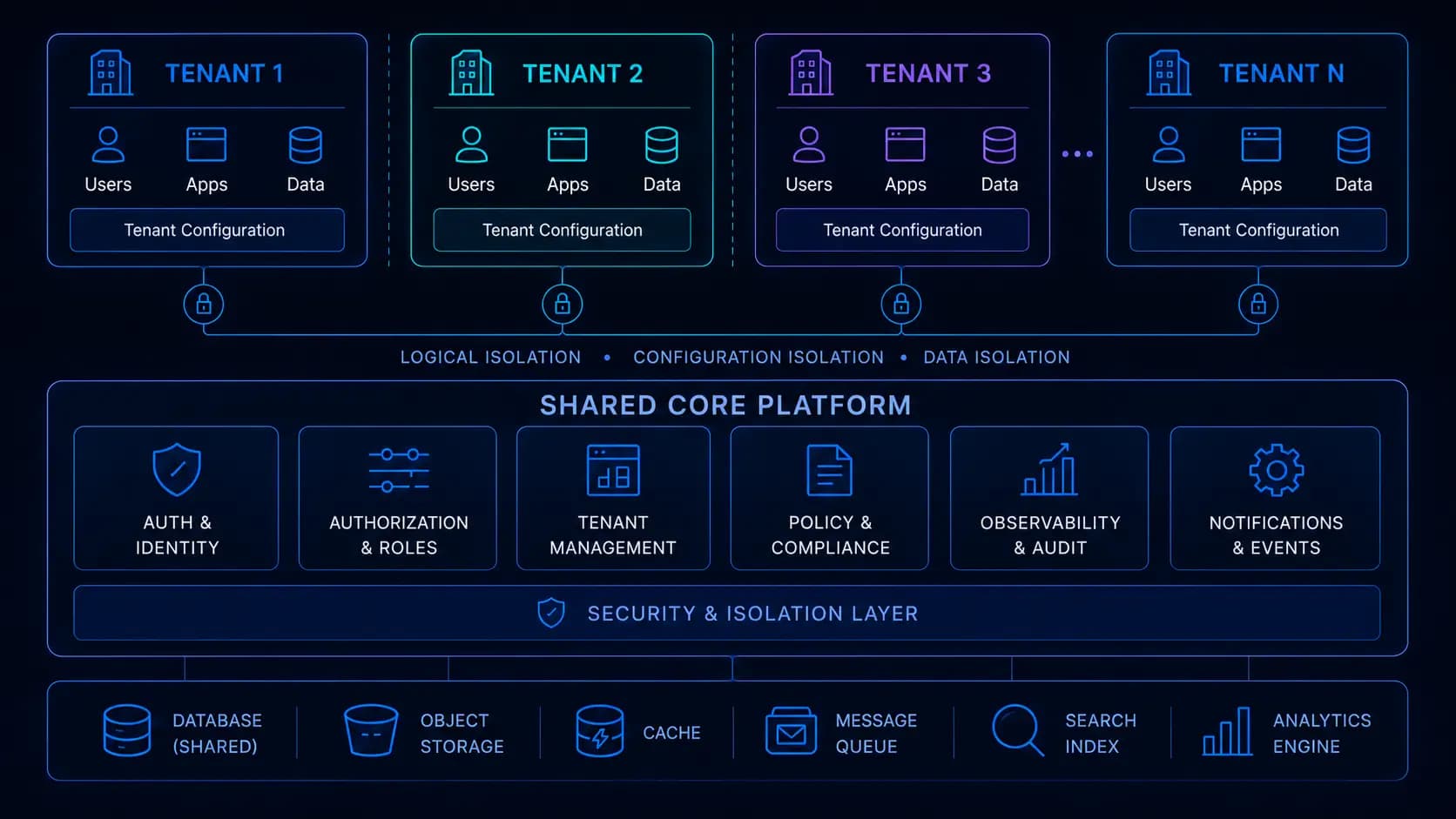
Multi-tenancy is one of those architectural decisions that appears straightforward early in a SaaS product's life and reveals its complexity as the product scales. The choices you make when your first customer signs up will determine how much pain you experience when your hundredth enterprise client requires data residency, your largest tenant starts degrading performance for everyone else, or a security incident requires you to isolate one tenant's data in under an hour. We have built multi-tenant systems from scratch and inherited others that were retrofitted with tenancy after the fact. The retrofits are always harder. Here is what to design from the start.
The three multi-tenancy models and their trade-offs
Shared database, shared schema: All tenants' data lives in the same tables, differentiated by a tenant_id column. This is the simplest model and works well for early-stage SaaS where operational simplicity is the priority. The risks are cross-tenant data leakage if tenant_id filtering is ever omitted, performance interference between tenants (a single large query by Tenant A degrades response times for Tenant B), and difficulty isolating data for enterprise clients who require it contractually.
Shared database, separate schemas: Each tenant has their own set of tables within a shared database instance. Better data isolation, easier tenant-level backup and restore, but schema migrations must be applied across all tenant schemas. A 500-tenant migration that takes 30 seconds per schema takes 250 minutes total. Plan accordingly.
Separate databases per tenant: Maximum isolation, enterprise-grade data residency, and the ability to scale individual tenants independently. It is also the most operationally complex: connection pool management, migration orchestration across hundreds of databases, and cross-tenant analytics (such as usage dashboards and aggregate metrics) require a data warehouse or ETL layer. This is appropriate for healthcare SaaS handling PHI, financial platforms, or any product selling to enterprise buyers who will ask, "where does my data live?"

Tenant identification and routing
Tenant identification must happen before any data access, at the API layer. The three common approaches are subdomain routing (tenant-slug.yoursaas.com), JWT claims (the tenant_id is embedded in the auth token and verified on every request), and API key prefix (the first segment of the API key identifies the tenant). We recommend JWT claims combined with subdomain routing for web applications: the subdomain provides user-facing tenant identity, while the JWT claim provides cryptographically verified tenant context for every API request. Every database query in your application must include tenant_id in the WHERE clause, enforced by a middleware layer, not by each individual query author.

The tenant isolation bug that ships in every SaaS
It ships in virtually every shared-schema SaaS at least once: a developer writes a query without the tenant_id filter, either accidentally or because they are writing an admin query that "should" see all data, and the bug reaches production. The mitigation is not to trust developers to remember; it is to make the correct behaviour the only easy behaviour. We implement tenant context as a thread-local or request-scoped variable that is automatically injected into a base query builder. Any query that reaches the database without tenant context throws an exception in development and logs a critical alert in production. The goal is to make omitting tenant isolation actively painful to do.
Noisy neighbour and resource isolation
In a shared-schema system, a single large tenant running a bulk export or a poorly optimised report can saturate your database and degrade response times for every other tenant. The standard mitigations are rate limiting at the tenant level, separate connection pools for background or batch operations versus real-time requests, and query timeouts enforced at the application layer. For enterprise plans where tenants have SLA guarantees, you will eventually need to offer dedicated database instances. Design your tenancy layer so moving a single tenant to a dedicated instance is an operational procedure, not a code change.

The migration problem at scale
Schema migrations in multi-tenant systems are one of the highest-risk operations you will perform. A migration that adds a NOT NULL column with no default locks each tenant's tables for the duration of the backfill. At 300 tenants with an average of 500,000 rows per table, this is not a migration you run during business hours. Design your migrations to be backwards-compatible and zero-downtime from the start: add nullable columns before making them required, use shadow tables for large data transformations, and build a migration orchestration system that can apply changes to tenant schemas in batches with rollback checkpoints.
Written by

Founder & CEO
Gaurang Ghinaiya is the Founder & CEO of Nexios Technologies. He is passionate about building innovative software solutions that drive business growth. With years of experience in technology leadership, he guides teams toward excellence.