React Native vs Flutter in 2025: What Shipping Both in Production Taught Us
We have shipped production apps in both React Native and Flutter for healthcare and e-commerce clients. Here's an honest comparison of performance, ecosystem, hiring, and the use cases where each framework excels.
The React Native vs Flutter debate has been running since Flutter's stable release in 2018, and the internet is full of benchmark articles and framework comparisons that treat the decision as a technical question. It is not primarily a technical question. It is a product, team, and business question that happens to have technical dimensions. We have shipped production mobile applications in both frameworks for clients across healthcare and e-commerce, and the decision factors are more nuanced than any framework comparison article will tell you.
Where React Native wins
React Native's primary advantage is ecosystem alignment. If your team already writes React for web, adding React Native means one mental model, shared business logic, and the ability to move engineers between platforms without a full context switch. For healthcare clients with web platforms running Next.js or React, this is a genuine productivity advantage, the same data fetching patterns, the same state management library, and shared TypeScript types across web and mobile. The React Native ecosystem is also larger: more third-party libraries, more Stack Overflow answers, and more engineers available to hire. When we are staffing a team for a client, React Native gives us a significantly wider candidate pool than Flutter.
React Native also has better native module support for specific healthcare integrations, Bluetooth LE for medical device connectivity, HealthKit and Health Connect APIs, and device camera integrations for document scanning all have more mature React Native libraries than Flutter equivalents.

Where Flutter wins
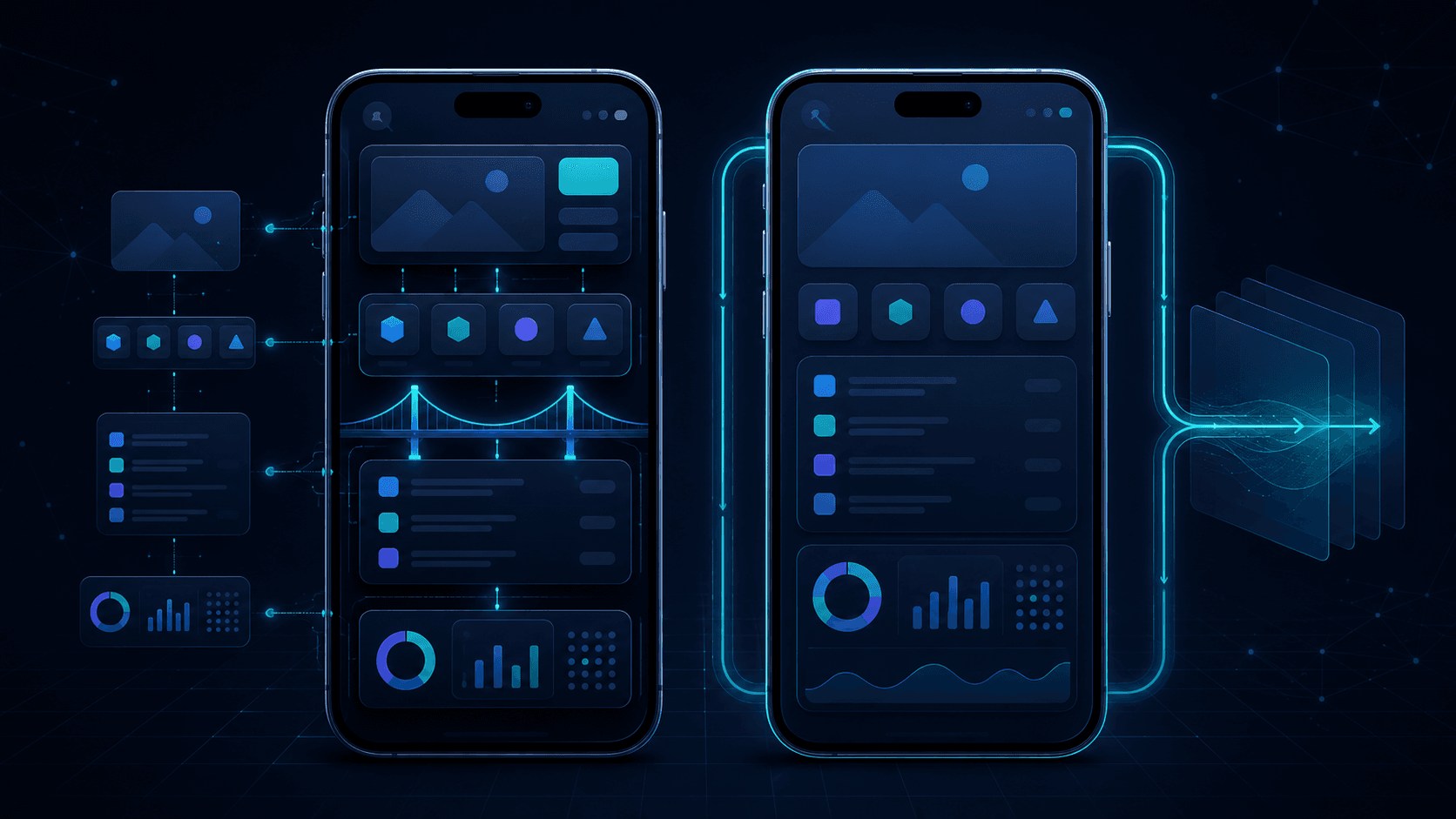
Flutter's rendering model is fundamentally different from React Native's. React Native bridges to native platform components; Flutter renders its own widget tree using the Skia or Impeller graphics engine. The practical consequence is that Flutter's UI is pixel-perfect across platforms by design, the app looks and behaves identically on iOS and Android without platform-specific styling. For design-intensive applications where the UI is a differentiator, luxury brand apps or high-end consumer products, Flutter delivers a level of visual control that React Native requires significant effort to match.
Flutter's performance on animation-heavy interfaces is also consistently better than React Native's. The JavaScript bridge is React Native's architectural liability; every interaction that crosses from JS to native has a latency cost. Flutter eliminates the bridge entirely. For applications with complex animations, gesture-driven interfaces, or real-time data visualisation, Flutter's rendering performance is measurably superior.

The cases that are genuinely clear
Choose React Native if your web stack is React or Next.js, you want code-sharing between platforms, your mobile features rely heavily on native OS integrations, or your hiring constraint favours JavaScript engineers. Choose Flutter if the UI is a primary differentiator, you need guaranteed visual consistency across platforms, your app is animation or graphics-intensive, or you are targeting platforms beyond iOS and Android (Flutter's web and desktop support are more mature than React Native's).

What actually matters more than the framework choice
The most consequential decision is not the framework, it is the data layer architecture. A React Native or Flutter app backed by a poorly designed API will perform badly regardless of how well the framework renders. Optimistic UI updates, offline-first data models, background sync strategies, and push notification handling are the engineering decisions that determine whether a mobile app feels fast and reliable. We have seen Flutter apps that feel sluggish because of poor API design, and React Native apps that feel instant because of well-architected data fetching. Choose the framework that fits your team and product requirements; architect the data layer with the same rigour you would apply to the backend that feeds it.
Written by

Founder & CEO
Gaurang Ghinaiya is the Founder & CEO of Nexios Technologies. He is passionate about building innovative software solutions that drive business growth. With years of experience in technology leadership, he guides teams toward excellence.