Subscription E-commerce Billing: The Engineering Behind Recurring Revenue
Subscriptions turn every order into a long-running state machine. Billing states, dunning flows, card updater services, and the churn you can engineer away.
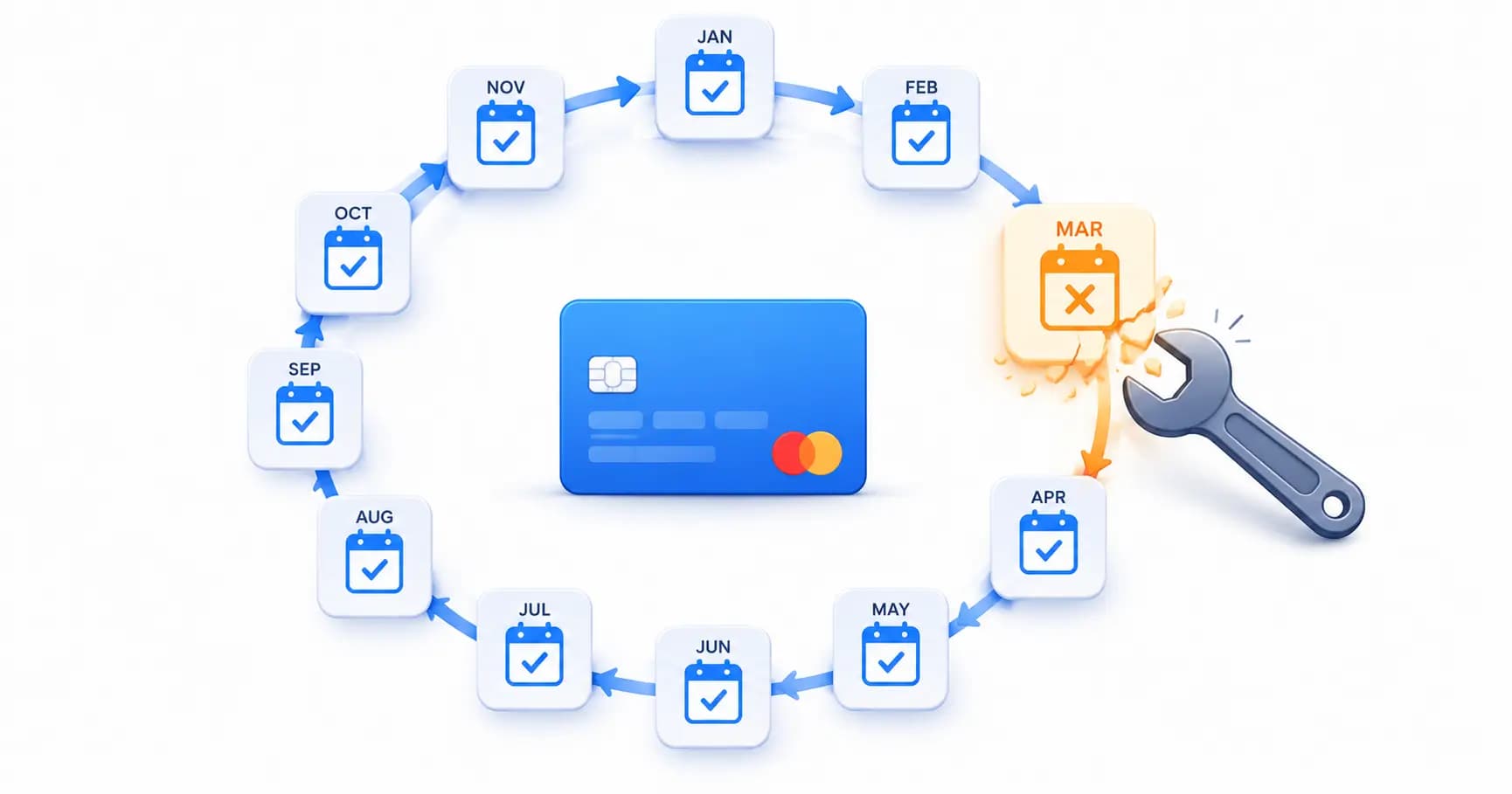
A one-time order is a transaction. A subscription is a long-running state machine that touches a customer's card every month for years, and every state transition is a chance to lose them, silently or loudly. Subscription e-commerce lives or dies on billing engineering: not the marketing definition of retention, but the mechanical one. This post covers the machinery.
The subscription state machine
Model the lifecycle explicitly or debug it forever. The states that production systems need: trialing, active, past_due, paused, pending_cancellation (cancels at period end), canceled, and expired. The transitions carry the business logic: what happens to a past_due subscriber's shipment? Does pausing extend the commitment? Every ambiguous answer becomes a support ticket and a refund.
- Anchor dates and proration: plan changes mid-cycle require proration math that customers can read on their invoice. Credit-and-rebill beats invisible adjustments.
- The billing attempt is not the order: charge first, then create the fulfillment order on success. Systems that create orders optimistically ship product to failed payments.
- Idempotency everywhere: billing jobs retry, webhooks redeliver. Every charge attempt carries an idempotency key, or a retry storm double-charges customers, the fastest way to lose trust and a chargeback fight at once.
Involuntary churn is an engineering problem
A third to a half of subscription churn is involuntary: the card expired, was reissued, or bounced off a limit. This is the churn you can engineer away:
- Card updater services: Visa and Mastercard account updater (via Stripe, Adyen, etc.) silently refreshes reissued cards. Turning it on is the single highest-ROI billing feature.
- Network-aware retry schedules: retrying a hard decline ("stolen card") is pointless; retrying an insufficient-funds decline on the customer's payday pattern works. Smart retries (3-5 attempts over 7-14 days, timed by decline code) recover a large fraction of failures.
- Dunning communication that converts: a payment-failed email with a one-tap "update card" link (no login wall), followed by SMS if permitted. The login wall is where recovery flows go to die.
- A grace state, not a cliff: past_due subscribers keep limited access while dunning runs. Cutting them off at first failure converts a fixable card problem into a decided cancellation.
Measure recovery rate per decline code and per retry slot. Teams that instrument this find their best-performing retry is not where the default schedule put it.
Voluntary churn: the cancellation flow is a product surface
The flow where a customer cancels is the highest-attention screen they will ever give you. Offer the alternatives that actually address their reason: pause (the top saver for consumables: "too much product" is a frequency problem, not a product problem), skip a shipment, swap the item, or downshift frequency. Log the reason codes; they are your churn research. Dark patterns (hidden cancel buttons, retention mazes) are now regulatory targets and brand damage; a clean flow with honest offers outperforms them anyway. The broader retention mechanics, post-purchase flows and repeat-order engineering, are covered in our post-sale engagement playbook.
Build on the processor, own the state
Stripe Billing, Recharge, and platform-native subscriptions all run the charge cycle for you, and for most stores that is the right call. The line to hold: your database owns subscription state; the processor executes payments. Webhooks update your state machine; your state machine decides fulfillment. Teams that treat the processor's dashboard as the source of truth cannot answer "which subscribers get a box on Monday" without an API crawl, and cannot switch processors without an archaeology project. This is the same boundary discipline as the webhook handling patterns we recommend for B2B APIs: verify signatures, process idempotently, reconcile on a schedule against the processor's records, because webhooks get missed.
The metrics that matter
- Involuntary churn rate separated from voluntary, and recovery rate on failed payments
- Net revenue retention including pauses, skips, and frequency downshifts, not just cancels
- Failed payment aging: how much MRR sits in past_due right now
- Save rate per cancellation reason, so the pause offer earns its place with data
Subscription billing is trust engineering: every silent success is invisible, and every mistake is a charge on someone's statement. If your subscription operation is growing past what platform defaults handle, or leaking revenue through dunning gaps, our e-commerce engineering team builds the state machines and recovery flows described here, including the build vs buy analysis of where your platform's native billing ends.
Written by

Founder & CEO
Gaurang Ghinaiya is the Founder & CEO of Nexios Technologies. He is passionate about building innovative software solutions that drive business growth. With years of experience in technology leadership, he guides teams toward excellence.