
E-commerce Search Engineering: Why the Search Box Decides Revenue
Shoppers who search convert at 2-3x the site average, and most search implementations fail them. Faceting, synonyms, ranking, and the build vs buy math.
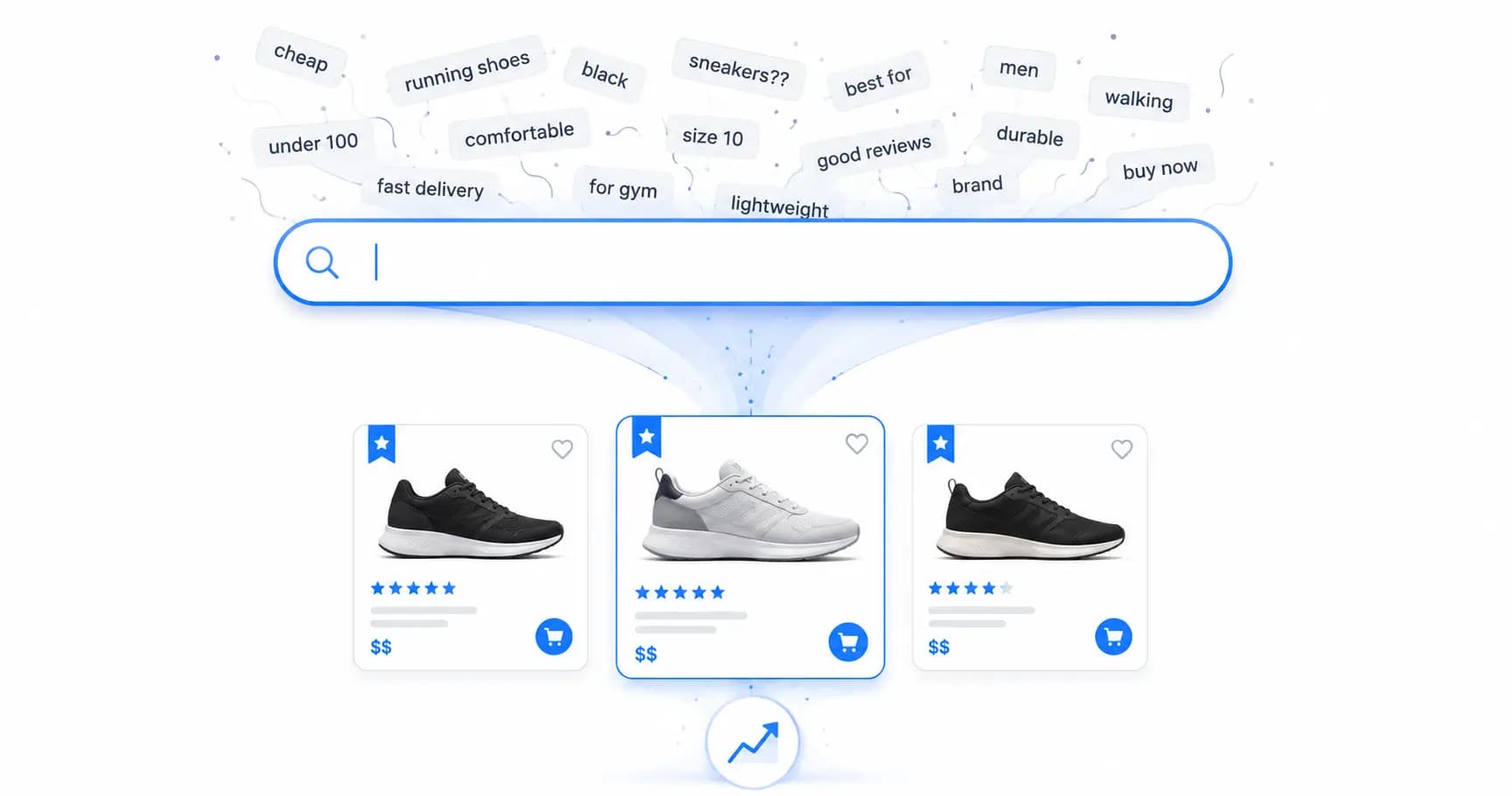
Shoppers who use site search convert at two to three times the site average, and they are the highest-intent visitors you have: they told you what they want in their own words. Most stores answer them with a default search box that fails on typos, ignores synonyms, and ranks by text match instead of business value. This post covers the engineering of search that earns its conversion premium.
The four layers of a search experience
- Query understanding: typo tolerance, synonyms ("hoodie" = "hooded sweatshirt"), attribute extraction ("red nike running shoes size 10" is a color + brand + category + size, not a phrase), and unit/format normalization.
- Retrieval: finding candidate products, classically by inverted index, increasingly hybrid with vector similarity for natural-language queries ("something warm for a fall wedding").
- Ranking: ordering candidates by a blend of relevance and business signals: margin, stock depth, conversion history, newness.
- Presentation: facets, instant results, zero-results recovery, and merchandising slots.
Most "our search is bad" complaints are failures in layer one or three. The retrieval engine is rarely the problem.
Faceting is a data quality problem
Facets (size, color, brand, price, material) are what make search usable on a large catalog, and they fail for a non-engineering reason: attribute data is inconsistent. "Navy," "navy blue," and "dark blue" are three facet values until someone normalizes them. The engineering answer is an attribute pipeline: controlled vocabularies per category, validation at product ingestion, and increasingly LLM-assisted extraction from product descriptions to fill missing attributes, the same extraction pattern we describe in our document processing pipeline guide, pointed at product data.
Facet UX has two rules worth enforcing: counts on every value (shoppers read "Red (3)" as "do not bother"), and no dead ends: a facet combination with zero results should never be clickable.
Ranking is where the money is
Pure text relevance ranks the product whose title matches best, which is often a low-margin accessory. Production ranking blends signals:
- Relevance: field-weighted text match (title over description), exactness bonuses
- Performance: click-through and conversion rate per product per query, with decay so last season's bestseller does not squat on results
- Business rules: stock depth (do not rank a nearly-sold-out size run first), margin tiers, launch boosts, brand agreements
- Personalization, applied last and lightly: category affinity re-ranking beats invasive per-user results, and it is measurable
The discipline that separates serious search: measurement. Track search conversion rate, zero-results rate, and refinement rate (searches immediately edited) per query, and review the top hundred queries monthly. The top queries are a merchandising surface, and the zero-results log is a free product-demand report that most teams never read.
Build vs buy: the honest math
| Option | Fits when | Watch out for |
|---|---|---|
| Algolia / Constructor / commercial search | You want query understanding, typo tolerance, and merchandising UI out of the box | Per-search pricing compounds with traffic; index size limits; you still own attribute quality |
| Elasticsearch / OpenSearch self-run | Large catalog, in-house search competence, custom ranking needs | You own relevance tuning end to end; "we installed it" is 20% of the work |
| Postgres full-text + pg_trgm | Catalogs into the low tens of thousands, one less system to run | Faceting performance and typo tolerance need care; fine until they are not |
| Platform default (Shopify search etc.) | Small catalog, standard queries | The ceiling is low and arrives quietly as the catalog grows |
Vector search deserves a sober note: hybrid retrieval genuinely helps long natural-language queries, and it is now cheap to add via the same vector stores used in RAG systems. But it does not fix bad attributes or bad ranking, and most stores get more revenue from fixing synonyms and facet data than from embeddings. Do the boring layer first. The broader point, that discovery AI beats chatbot AI for commerce, is one we made in the AI feature your e-commerce platform actually needs.
Architecture notes for headless stores
In a decoupled storefront, listing and search pages should query the search index directly, not the commerce API: it is faster and the faceting is better, as covered in our headless commerce guide. Keep the index fresh with webhook-driven updates (price, stock, publish state) rather than nightly rebuilds, and treat "time from price change to index update" as a monitored SLO. Stale search results are how customers find yesterday's price.
Search is the highest-leverage surface on a store that has traffic: improvements compound on every session, forever. If your search is losing shoppers you already paid to acquire, our e-commerce engineering team builds the full stack described here, from attribute pipeline to ranking measurement.
Written by

Founder & CEO
Gaurang Ghinaiya is the Founder & CEO of Nexios Technologies. He is passionate about building innovative software solutions that drive business growth. With years of experience in technology leadership, he guides teams toward excellence.