AI Document Processing: OCR + LLM Extraction Pipelines That Hold Up
Invoices, intake forms, contracts: document extraction is now an LLM pipeline problem. Architecture, confidence thresholds, and the review queue design.
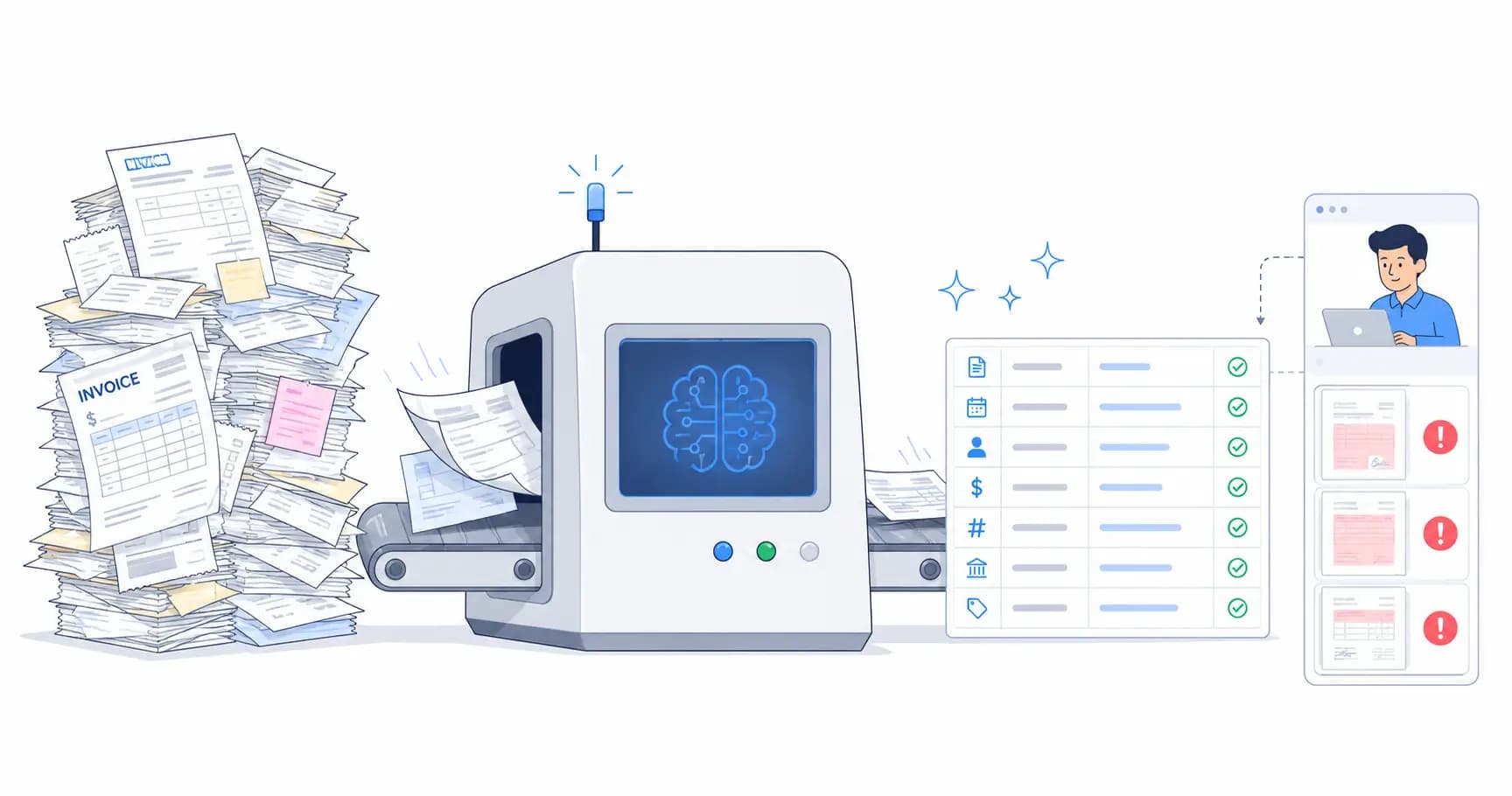
Invoices, intake forms, contracts, lab reports, shipping documents: every operations-heavy business has a stream of documents that someone reads and retypes into a system. Document extraction used to mean brittle template OCR that broke when a vendor redesigned their invoice. LLMs changed the economics: one pipeline now handles layout variety that used to require a template per sender. What has not changed is that production accuracy comes from pipeline engineering, not model choice. This guide covers the architecture.
The pipeline shape
Every production document AI system converges on the same five stages:
- Ingestion and classification: documents arrive by email, upload, scan, or API. First decision: what is this (invoice, PO, intake form, other), because each type has its own schema and rules downstream.
- Text extraction: digital PDFs yield text directly; scans and photos need OCR. Modern vision-capable LLMs can read images directly, but dedicated OCR (with coordinates and confidence per token) still wins for dense tables and poor scans, and the hybrid (OCR text + page image to a vision model) is the current accuracy champion for hard documents.
- Structured extraction: the LLM maps document content into a typed schema, using strict structured output, the same contract pattern from our LLM integration patterns: fields, types, enums, required flags.
- Validation and confidence: extracted data is checked against reality before anyone trusts it.
- Review and delivery: high-confidence documents flow straight to the destination system; the rest queue for humans.
Validation is the accuracy multiplier
The LLM will produce a plausible value for every field, including the ones it misread. Plausible is the problem: wrong-but-well-formatted data sails into downstream systems. The validation layer catches it with checks the model cannot fake:
- Arithmetic checks: line items sum to subtotal, subtotal plus tax equals total. An invoice that fails its own math gets flagged regardless of model confidence.
- Cross-reference checks: vendor exists in the vendor master, PO number matches an open PO, patient ID resolves. Reality is the best validator.
- Format and range rules: dates in plausible windows, currency codes valid, quantities positive.
- Source grounding: for critical fields, verify the extracted string actually appears in the OCR text (fuzzy-matched). This single check kills most hallucinated values, the same grounding principle as our anti-hallucination stack.
Confidence routing and the review queue
Per-field confidence (model-reported, OCR confidence, and validation results combined) drives routing: documents where every critical field passes go straight through; anything else lands in a review UI. The review queue design determines whether the system actually saves labor:
- Show the document and the extraction side by side, with each field linked to its source region on the page (this is why OCR coordinates matter).
- Reviewers correct fields, not documents: the 90% that extracted cleanly stays untouched.
- Every correction is training data. Corrections feed the eval set and prompt iteration, so the straight-through rate climbs over time. This loop is the product; measure straight-through-processing rate weekly, per the discipline in our evaluation framework guide.

Volume economics
Per-document LLM cost is cents; the economics are dominated by the review rate. A pipeline at 80% straight-through with a 90-second average review beats a 95%-accurate-but-unvalidated pipeline that pushes silent errors downstream, because the cost of a wrong invoice in the ERP is not 90 seconds. Batch tiers cut model spend in half for non-urgent backfills, and model routing (small model for classification, larger for extraction on hard documents) applies directly, both covered in our LLM cost optimization guide.
Compliance notes for regulated documents
Healthcare intake forms and clinical documents make the pipeline a PHI system: BAA-covered OCR and LLM endpoints only, PHI-scrubbed logging, and access-audited review queues, the full treatment in our BAA engineering guide. Financial documents bring retention and auditability requirements: keep the source document, the extraction, and the correction history linked, so any downstream number traces back to pixels.
Document processing is one of the highest-certainty AI investments available right now: the labor being replaced is measurable, the accuracy is testable, and the ROI math fits on one page. If your team is still retyping documents into systems, our AI automation team builds these pipelines end to end, from ingestion through the review queue.
Related service
AI Development & Automation
Production RAG pipelines, LLM integrations, and AI workflow automation for healthcare and e-commerce.
Written by

Founder & CEO
Gaurang Ghinaiya is the Founder & CEO of Nexios Technologies. He is passionate about building innovative software solutions that drive business growth. With years of experience in technology leadership, he guides teams toward excellence.