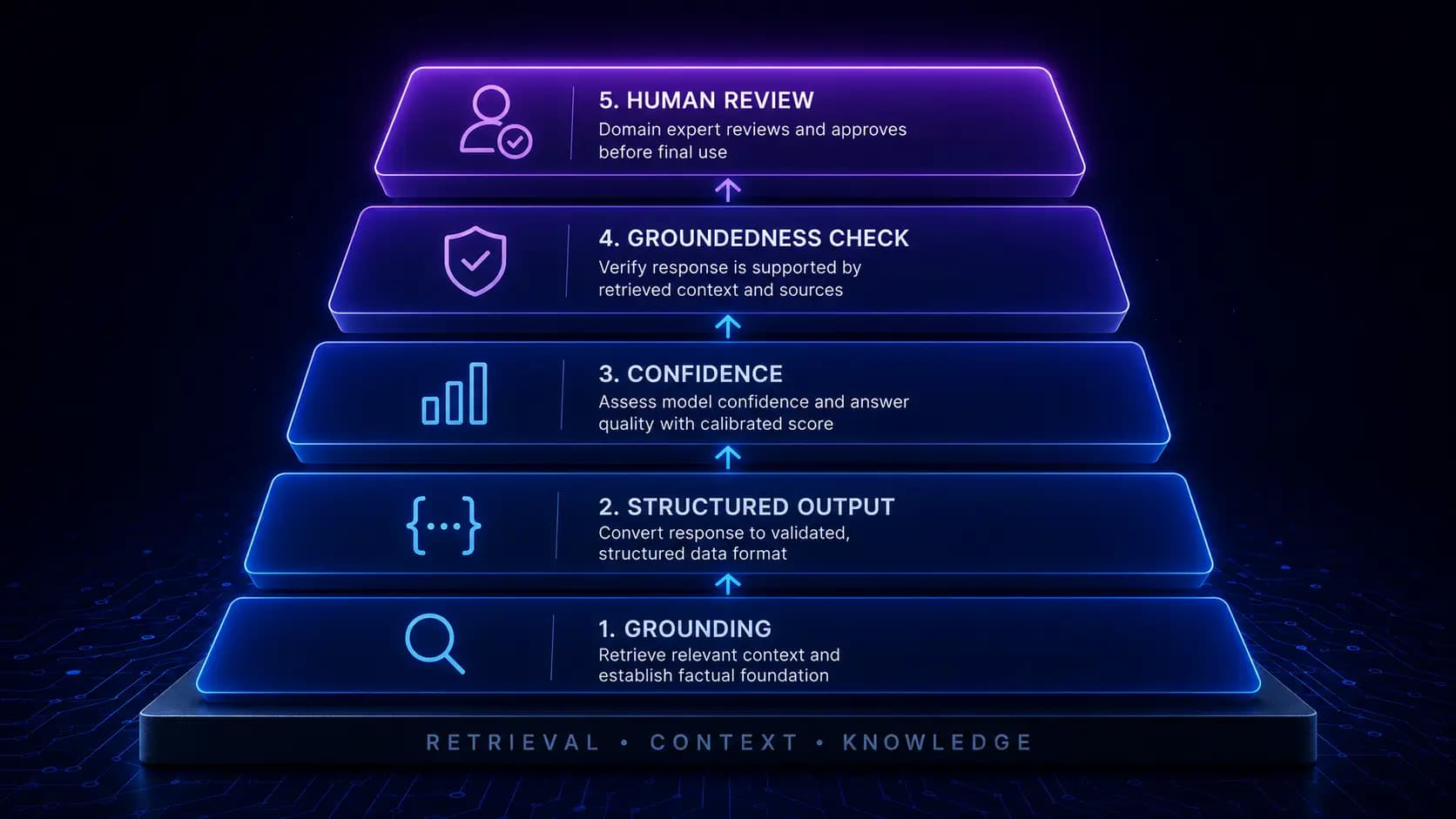
LLM Evaluation Frameworks: Proving Your AI Feature Actually Works
"It seems good" does not survive procurement. Eval set construction, judge models, regression gating, and the metrics that hold up in an enterprise deal.
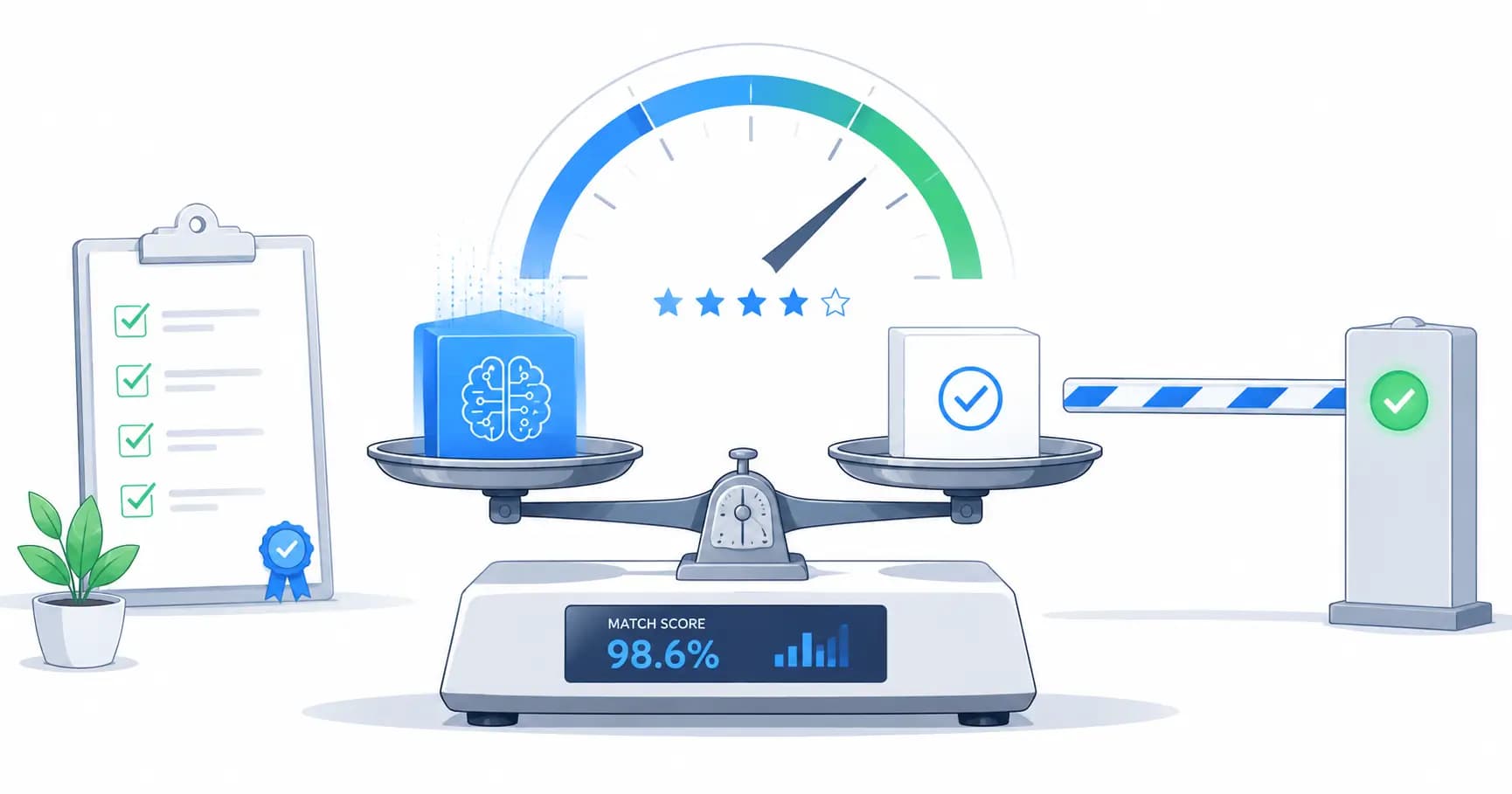
Every LLM feature demo ends the same way: it looks great, everyone nods, and then someone from the enterprise buyer's side asks "what's your accuracy?" and the room goes quiet. "It seems good" does not survive procurement, does not survive a model upgrade, and does not survive the first support escalation with an executive on the thread. An evaluation framework is how AI features graduate from demo to product. This guide covers building one that holds up.
The eval set is the foundation
An evaluation set is a corpus of real inputs with reviewed expected outputs, and its quality determines everything downstream:
- Source from production, not imagination. Real (permissioned, de-identified) user queries and documents, because synthetic test cases miss the weirdness that actually breaks systems: typos, mixed languages, questions that assume false premises.
- Stratify deliberately: common cases by volume, hard cases by category (ambiguous queries, out-of-scope requests, adversarial inputs), and a refusal set: inputs where the correct answer is "I can't answer that." Systems that never test refusal ship confident nonsense, the failure mode we dissected in why AI chatbots hallucinate.
- Size honestly: 50 cases finds gross regressions; 300-500 stratified cases gives you percentages worth putting in a sales deck. Start small and grow from production, especially from corrections and complaints, the same loop as our document pipeline review queue.
Scoring: exact checks where possible, judges where necessary
Score with the cheapest reliable method per criterion:
- Deterministic checks for anything structured: schema validity, required fields, citation IDs that resolve, numbers that match the source. Free, fast, and unarguable.
- LLM-as-judge for semantic criteria (correctness vs reference, groundedness in retrieved context, tone). It works, with known pitfalls: judges prefer longer answers, prefer their own model family's style, and drift across judge-model versions. Mitigations: pin the judge model version, use binary or 3-point rubrics per criterion instead of 1-10 scores, include reference answers in the judge prompt, and calibrate the judge against a human-labeled sample (aim for 90%+ agreement before trusting it).
- Human review for the calibration sample and for high-stakes categories. Humans are the ground truth the judge is approximating, not a fallback.
Score criteria separately: answer correctness, citation correctness, refusal correctness, and format compliance are different numbers. An update that answers more questions by citing worse sources is a regression wearing an improvement's clothes.
Regression gating: evals as CI
The framework earns its keep when it blocks a bad change. Wire the eval run into the deployment path for anything that alters model behavior: prompt edits, model upgrades, retrieval changes, tool schema changes. The gate policy that works in practice:
- Hard thresholds per criterion (correctness may not drop more than X points; refusal accuracy may not drop at all).
- Category-level visibility: a flat aggregate hides "healthcare queries got worse while chitchat got better."
- Diff review for the cases that flipped: which specific inputs regressed, viewable side by side. This turns "the score dropped" into a fixable bug report.
This is what makes cost optimization safe: model downgrades and context trims run through the same gate as feature changes, so saving money cannot silently cost quality. Prompt changes deployed as config (per our integration patterns) get the same treatment: version, evaluate, promote.
Online evaluation: production is the real test set
Offline evals predict; production confirms. The online layer:
- Sampled human review of live outputs on a schedule, weighted toward new categories and low-confidence responses.
- Implicit signals: thumbs down, retry rate, edit distance on drafts users correct, escalation-to-human rate. Each is a weak signal; trended together they are an early-warning system.
- Feedback-to-eval-set pipeline: every confirmed production failure becomes a permanent eval case. This is the ratchet: the system cannot regress on a failure twice.
What enterprise buyers actually ask
Procurement and security reviews converge on the same questions: what is your measured accuracy and on what corpus, what happens when the model is wrong, how do you prevent regressions, and can we see category-level numbers for our domain. A team with a stratified eval set, gated deployments, and a production feedback loop answers all four in one slide. A team without one discovers these questions at contract time, which is the expensive time to start. For agent products, where outputs are actions rather than answers, the same framework gates autonomy increases, as covered in our AI agents guide.
Evaluation is the difference between shipping an AI feature and operating one. If your team is running on vibes and a demo script, our AI engineering practice builds evaluation frameworks alongside the features they protect, eval set through regression gate.
Related service
AI Development & Automation
Production RAG pipelines, LLM integrations, and AI workflow automation for healthcare and e-commerce.
Written by

Founder & CEO
Gaurang Ghinaiya is the Founder & CEO of Nexios Technologies. He is passionate about building innovative software solutions that drive business growth. With years of experience in technology leadership, he guides teams toward excellence.