AI Agents for Business Automation: What Works Beyond the Demo
Agents are LLMs with permission to act. Where they beat RPA, how to design tools they cannot misuse, and the guardrails that make them deployable.
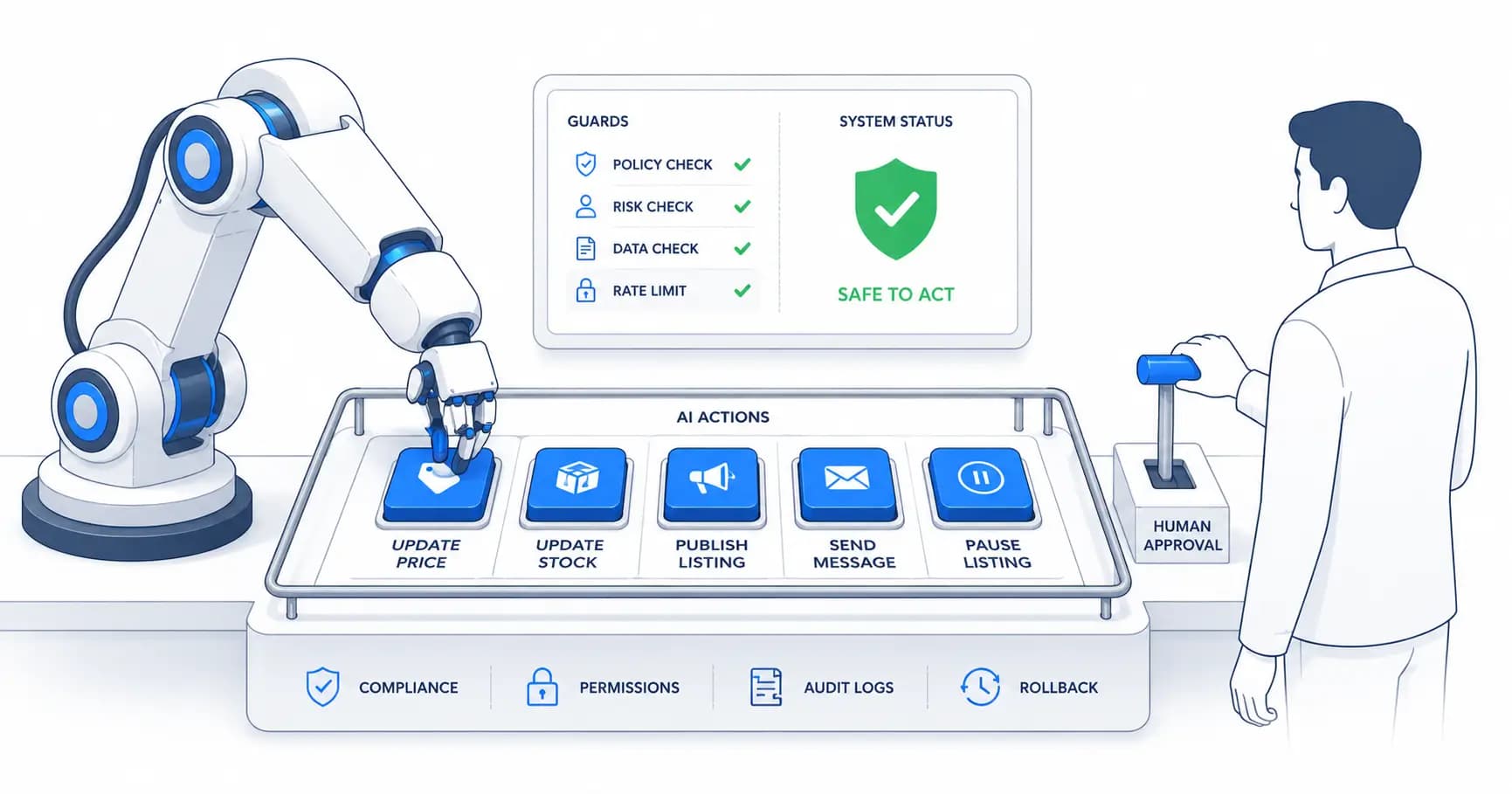
An AI agent is an LLM with permission to act: read your systems, decide, and do something, in a loop, without a human writing each step. That definition explains both the excitement and the incidents. Agents are genuinely better than scripts and RPA at a specific class of work, and genuinely dangerous when handed the wrong class. This guide covers where agents earn production status and the engineering that keeps them there.
Where agents beat scripts and RPA
Deterministic automation wins whenever the process is deterministic: same steps, same systems, same shapes. Agents win where the input is messy and the decision requires reading:
- Triage and routing: support tickets, inbound documents, vendor emails: classify, extract, route, draft. The input variety is exactly what killed the regex version.
- Multi-system lookups with judgment: "check the order system, the carrier API, and the refund policy, then decide what this customer gets" is an agent-shaped task.
- Exception handling inside deterministic pipelines: the happy path stays code; the 5% that used to page a human becomes an agent with an escalation path.
- Document-heavy workflows: intake, reconciliation, compliance checks, built on the extraction patterns from our document processing pipeline guide.
The anti-pattern is the inverse: giving an agent a task that a cron job does perfectly, and paying token costs plus nondeterminism for the privilege.
Tool design is the real engineering
An agent is only as safe as its tools. The model does not need to be trusted; the tools need to be designed so misuse is impossible:
- Narrow, typed tools beat general ones:
issue_refund(order_id, amount_capped_by_policy), neverrun_sql(query). The cap lives in the tool, not the prompt. - Reads are free, writes are gated. Retrieval tools run freely; mutating tools carry per-tool authorization: which agent, which limits, which contexts.
- Idempotency and dry-run: every write tool accepts an idempotency key and supports a preview mode, so the loop can retry safely and the human gate below has something concrete to approve.
- Tenant scoping at the tool layer: in multi-tenant products, the tool enforces data isolation, the same non-negotiable from our LLM integration patterns.
Autonomy is a dial, not a switch
Production agents ship at the lowest autonomy that delivers value, and earn more:
- Draft mode: the agent proposes; a human approves every action. This is where every deployment should start, because it generates the evaluation data for the next step.
- Threshold autonomy: low-risk actions execute (refunds under $50, standard replies); everything else queues for approval. The threshold is a policy object you tune with data, not a prompt line.
- Monitored autonomy: the agent acts; sampled reviews and anomaly alerts watch the aggregate. Reserved for workflows with cheap reversibility.
Reversibility is the sorting key: sending an internal summary is instantly reversible; emailing a customer is awkwardly reversible; a payment or a deletion is not. Map every tool to that ladder before deciding its gate.
Failure containment
Agents fail in new ways: loops that never converge, tool-call storms, confidently wrong extractions feeding downstream actions. The containment set we consider mandatory:
- Budgets per run: max steps, max tokens, max wall time, max spend. Exceeded budgets stop and escalate, never silently truncate.
- Full trajectory logging: every prompt, tool call, and result, replayable. When the agent does something odd, "why" must be answerable from the log, which is also your audit story in regulated environments.
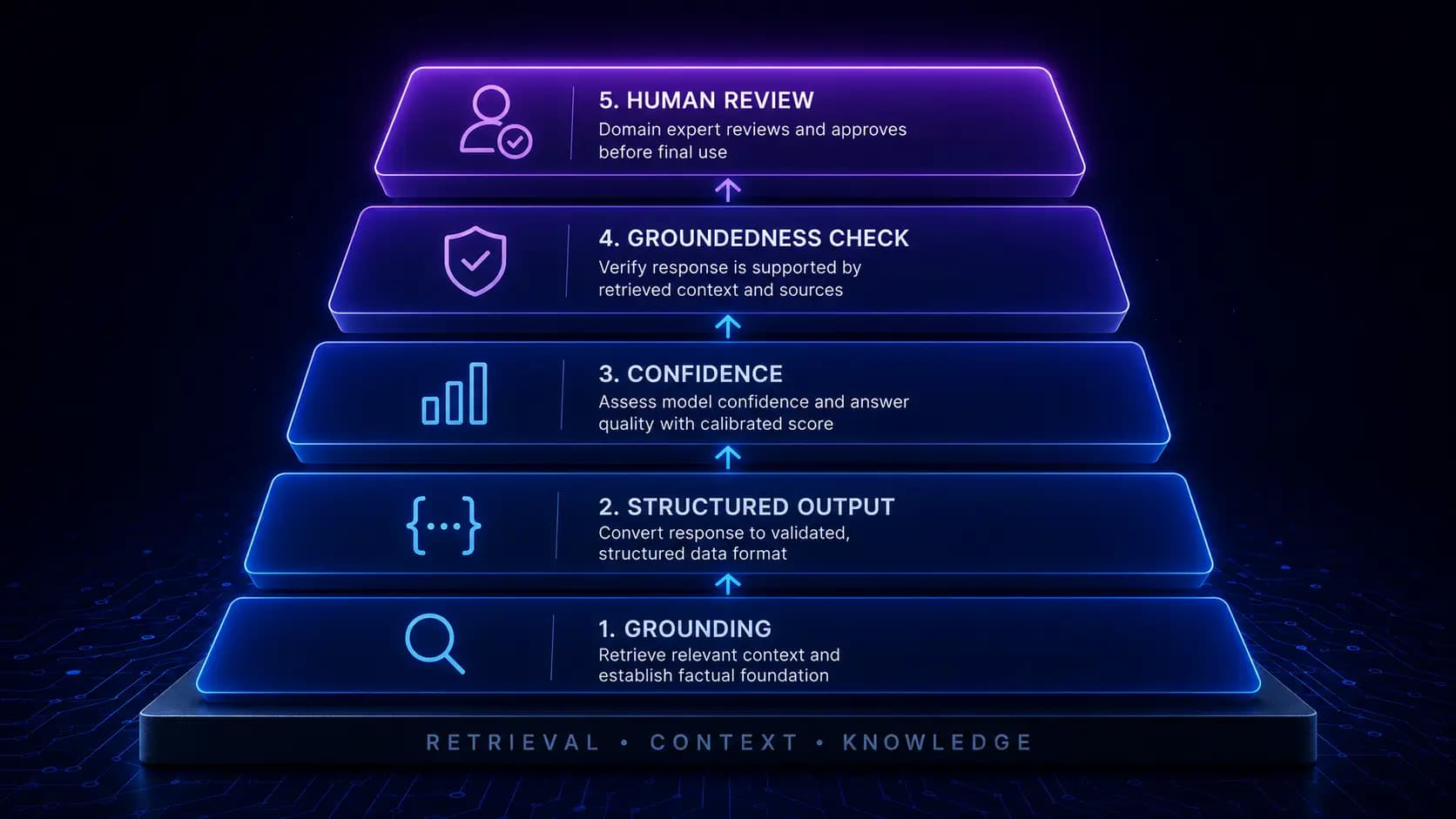
- Grounding checks on claims: before an agent acts on an extracted fact, the fact carries a confidence and a source, the anti-hallucination stack applied to actions instead of answers.
- Evaluation before autonomy increases: the draft-mode corpus becomes the eval set, per our LLM evaluation framework. Autonomy upgrades are gated on measured accuracy, not vibes.

The ROI shape
Agent economics work when the task volume is high, the per-task human cost is minutes, and the error cost is capped by design. A triage agent saving four minutes on each of 300 daily tickets pays for a lot of tokens; an agent drafting one contract a week does not need to exist. Instrument cost per completed task and deflection rate from day one, using the same attribution layer as our LLM cost optimization guide, because "the agent is neat" and "the agent is cheaper than the queue it replaced" are different claims.
Agents are the most leveraged and least forgiving LLM deployment pattern: the wins are real and so are the incident reports. If you have a workflow that looks agent-shaped, our AI automation team builds them with the tool gates, autonomy ladder, and evaluation discipline described here.
Related service
AI Development & Automation
Production RAG pipelines, LLM integrations, and AI workflow automation for healthcare and e-commerce.
Written by

Founder & CEO
Gaurang Ghinaiya is the Founder & CEO of Nexios Technologies. He is passionate about building innovative software solutions that drive business growth. With years of experience in technology leadership, he guides teams toward excellence.