Home Health Scheduling Software: EVV, Routing, and Compliance Engineering
Home health scheduling is constraint satisfaction with regulatory teeth. EVV, credential matching, drive-time budgets, and the schedule change that happens at 6am.
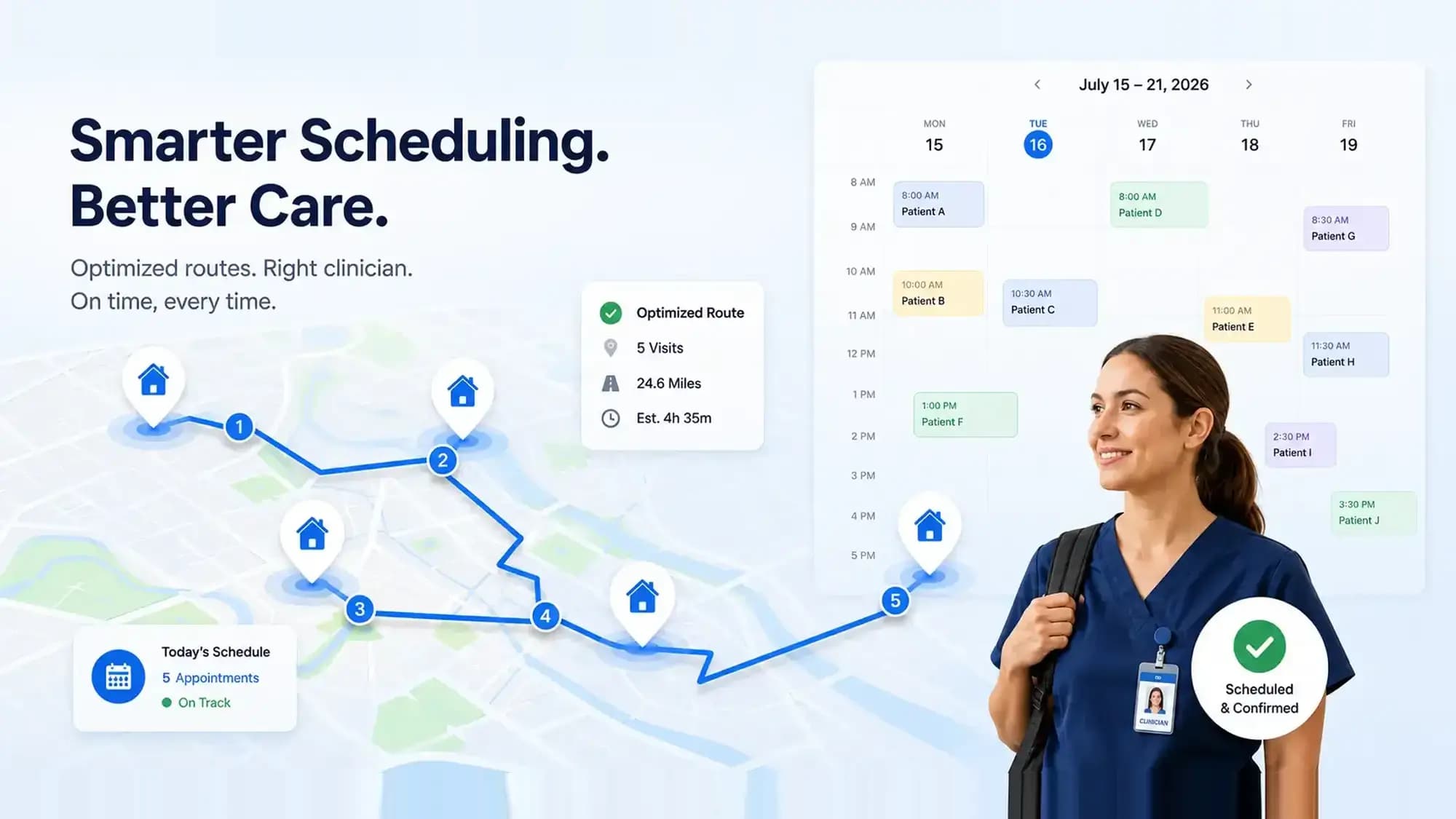
Home health scheduling looks like a calendar problem until you try to build it. It is actually constraint satisfaction with regulatory teeth: the right clinician, with the right credentials, at the right patient, inside an authorization window, verified electronically for Medicaid, rescheduled three times before breakfast. This post covers the engineering behind scheduling software that agencies actually keep using.
The constraint stack
A valid visit assignment has to clear every layer:
- Discipline and credential match. The visit requires an RN, PT, OT, or aide with specific certifications; licenses expire and the scheduler must refuse assignments past expiry.
- Authorization limits. Payers authorize N visits of a discipline in a date range. Scheduling visit N+1 creates unbillable work, so the authorization balance is a hard constraint, not a report.
- Continuity preferences. Patients do better with consistent clinicians; agencies want the same aide Monday and Thursday, not whoever is free.
- Geography and drive time. A clinician's day is a route, not a list. Back-to-back visits 40 minutes apart are a paper schedule that fails in the field.
- Clinician constraints. Availability windows, max visits per day, no-lift restrictions, language match.
The practical algorithm is not exotic: score candidate assignments against the constraint stack, hard constraints filtering and soft constraints ranking, with drive time from a routing API cached per clinician-patient pair. What matters is that violations are impossible to save, not flagged in a weekly report.
 Every assignment clears five layers. Hard constraints filter; soft constraints rank.
EVV is not optional
The 21st Century Cures Act made Electronic Visit Verification mandatory for Medicaid personal care and home health services. Six data points per visit: service type, individual receiving it, individual providing it, date, location, and start/end time. Engineering implications:
- Mobile check-in/out with GPS capture, tolerant of dead zones: capture locally with a device timestamp, sync when connectivity returns, and flag manual edits separately from device-captured times. Auditors care about the difference.
- State aggregator integration. Most states route EVV data through an aggregator (Sandata, HHAeXchange, Tellus) with state-specific formats and rejection rules. Treat each state as its own integration with its own retry queue.
- Exception workflow. Missed check-ins, geofence mismatches, and manual corrections need a supervisor review queue with reason codes, because uncorrected exceptions become unpaid claims.
The 6am reschedule is the real workload
A clinician calls out sick at 6:05am with nine visits scheduled. The scheduler's next fifteen minutes decide whether patients get missed visits. This is where scheduling software earns its keep:
- One-tap "reassign day" that re-runs the constraint stack across the available pool and proposes a redistribution, not nine separate manual searches.
- Notification fan-out to affected clinicians and, where appropriate, patients or family, through channels that do not leak PHI (content-free push, per our HIPAA mobile guide).
- An audit trail of who moved what and why, because missed-visit disputes surface weeks later in QA and payer audits.
 The callout flow: re-solve the day in one action, notify everyone, audit everything.
Integration with the EMR of record
Agencies run their clinical documentation in an EMR (Homecare Homebase dominates larger agencies), and the schedule must reconcile with it. Bidirectional sync is the hard version: visit status flows both ways, and conflicts (a visit documented in the EMR but moved in your scheduler) need deterministic resolution rules. We documented the realities of this in our HCHB integration architecture post; the general problem, and why agencies outgrow the built-in tools, is the subject of why home health agencies outgrow generic communication tools.
Metrics that tell you it works
- Missed visit rate and its reason distribution (callout, patient refusal, scheduling error)
- Continuity score: percent of visits by a patient's primary clinician
- EVV exception rate and time-to-resolution
- Windshield time per clinician-day, the drive-time budget the router is supposed to minimize
- Authorization utilization: visits scheduled vs authorized, so unused authorizations surface before they expire
Scheduling is where home health margins live: a point of missed-visit rate or an hour of daily windshield time is real money at agency scale. If your agency or your product is fighting a generic calendar, our healthcare engineering team builds scheduling systems with the constraint stack, EVV, and EMR sync described here, workflow-first, like the coordination platform in our care coordination case study.
Written by

Founder & CEO
Gaurang Ghinaiya is the Founder & CEO of Nexios Technologies. He is passionate about building innovative software solutions that drive business growth. With years of experience in technology leadership, he guides teams toward excellence.