Why Home Health Agencies Outgrow Generic Communication Tools
Microsoft Teams does not know what an ADT event is. Here is why home health agencies need purpose-built software — and what happens when they try to make generic tools work.
There's a conversation I've had more times than I can count with administrators at home health agencies. It goes something like this: they're using a combination of Microsoft Teams, email, phone calls, and whatever their EMR offers natively, and coordination is a mess. Clinicians are losing time hunting for context. Things fall through the cracks. And when I ask what they've tried to fix it, the answer is usually some version of "we've configured Teams as much as you can configure Teams."
The problem isn't how they've configured Teams. The problem is that Teams was never built for home health. Neither was Slack, or email, or any other general-purpose communication tool. And no amount of channels, workflows, or integrations will make a generic tool understand what your business actually requires.

The context problem
Every industry has its own vocabulary, its own workflows, and its own data model. Home health has a particularly specific one: patients are admitted, discharged, and readmitted. They have episodes of care. They receive visits from clinicians in the field. They have IDG (Interdisciplinary Group) meetings. Their care is coordinated between field clinicians, office staff, administrators, and their EMR.
When a patient is admitted to a home health agency triggered by a hospital discharge that's an ADT event (Admission, Discharge, Transfer). The agency's clinical team needs to know about it immediately. The scheduling team needs to assign a clinician. The coordinator needs to open an episode. The billing team needs the admission date. All of that flows from one event.
In a purpose-built system, an ADT event triggers all of those downstream actions automatically. In Teams, someone has to post a message in a channel, hope the right people see it, and manually kick off each downstream step. That's not a configuration problem it's a fundamental architectural mismatch. Teams doesn't have a concept of an ADT event, an episode, or an IDG meeting. It has channels and messages.
What generic tools cost you in real time
The friction isn't abstract. It shows up in specific, measurable ways every single day.
Clinician time
When a clinician finishes a visit and needs to update the care team, they're navigating between their EMR, a Teams channel, their phone, and whatever documentation system the agency uses. The coordination overhead finding the right channel, checking whether anyone else has already posted an update, and hunting for the patient's current episode status costs 12 to 15 minutes per clinician per day on average. Multiply that across a 30-clinician agency and you're losing 6 to 7 hours of clinical time every day to coordination friction.
Admin time
The administrative burden of manually coordinating between systems is even heavier. Checking whether an IDG meeting has been documented. Cross-referencing admission dates between the EMR and whatever tracking system the agency maintains separately. Following up on coordination notes that were posted in Teams but never made it into the clinical record. We've seen agencies where administrative staff spend 18 to 25 minutes per day just on tasks that a purpose-built system would handle automatically.
Readmissions
This is the one that gets expensive fast. When coordination breaks down when a patient's status change doesn't reach the right clinician in time, or when a visit gets missed because the scheduling update was in a Teams thread nobody checked the downstream risk is a hospital readmission. Readmissions are costly for agencies on value-based care arrangements, and they're a core quality metric. Agencies that coordinate well have significantly lower readmission rates. The coordination tooling is a direct factor.

The EMR integration problem
Every home health agency runs on an EMR. In the US home health market, HCHB (Homecare Homebase) is the dominant player. PointClickCare, Netsmart, and a handful of others cover most of the rest.
The data that lives in the EMR patient demographics, episode information, visit records, and clinical documentation is the source of truth. Any coordination platform that doesn't connect to the EMR is, by definition, working with incomplete information. Clinicians end up maintaining two sources of truth: the EMR and whatever the coordination tool knows. That duplication is where errors happen.
Generic communication tools don't integrate with home health EMRs. Teams has no HCHB connector. Slack has no PointClickCare integration. Building one yourself is possible in theory, but it requires understanding the specific data formats those EMRs use ADT feeds, MDM (Medical Document Management) messages, and the specific HL7 message structures each EMR sends.
We built a bidirectional integration with HCHB for a home health client CareCoordinations that handles ADT feeds, MDM attachments, and coordination notes. When a patient is admitted in HCHB, the coordination platform knows immediately. When a coordination note is created in the platform, it syncs back to HCHB. That kind of real-time, bidirectional data flow is what genuinely closes the coordination gap.
What purpose-built coordination software actually does
Let me be specific about what a purpose-built home health coordination platform provides that generic tools can't not in theory, but in actual functionality.
Episode-aware context
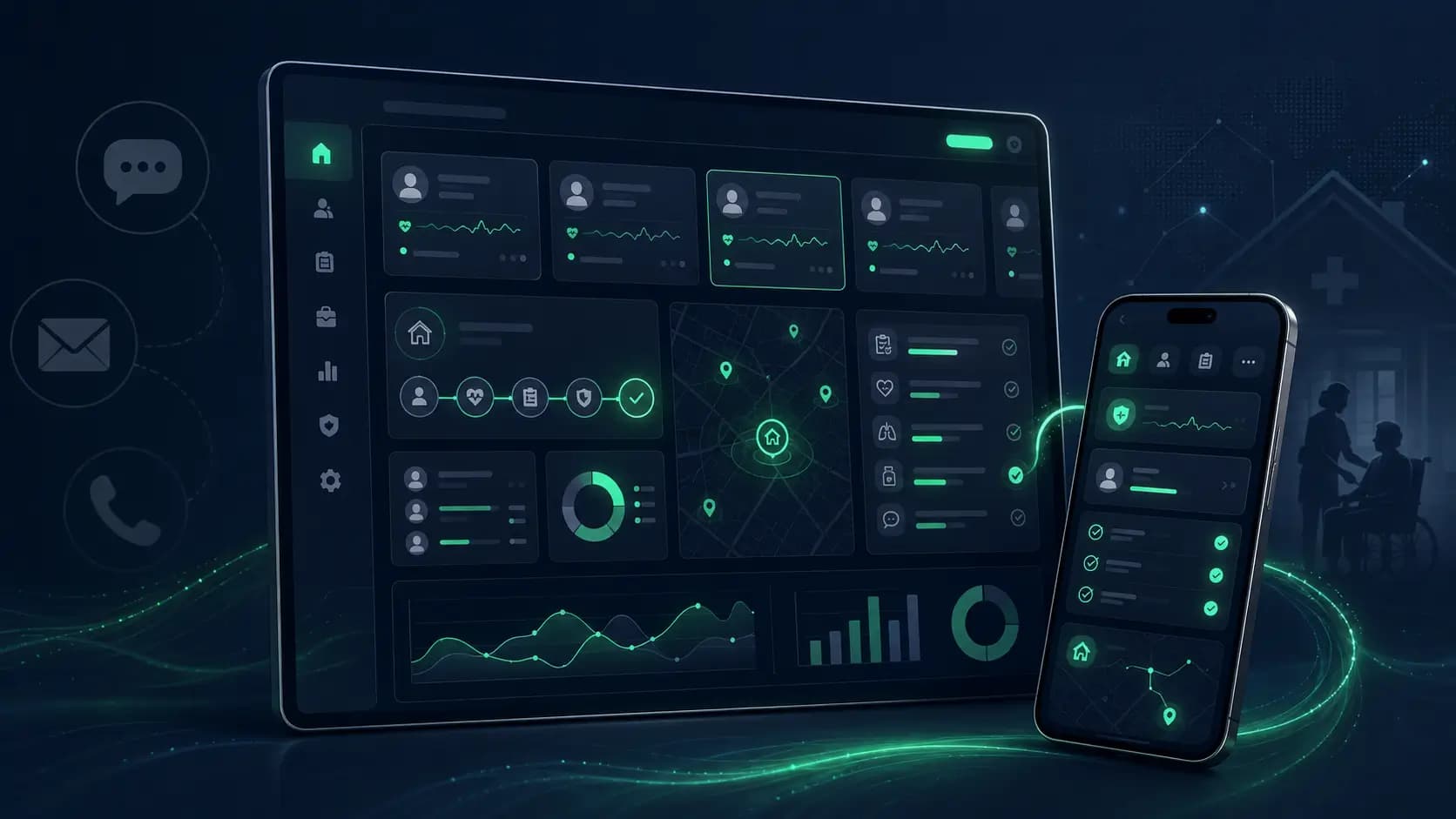
Every piece of communication, every coordination note, and every task is tied to a patient episode not to a channel or a thread. When a clinician needs to check on a patient's status, they open the patient's episode, not a Teams channel. Everything relevant to that patient's current episode of care is in one place.
ADT-driven workflows
When an ADT event fires from the EMR, the platform responds: the appropriate team members are notified, the episode is opened or updated, and the relevant tasks are triggered. This happens automatically, not because someone posted in a channel.
IDG meeting support
Interdisciplinary Group meetings are a core part of home health care coordination. A purpose-built platform has IDG as a first-class concept scheduling, documentation, attendee management, and outcome recording, all tied to the relevant patient episodes.
Field clinician apps
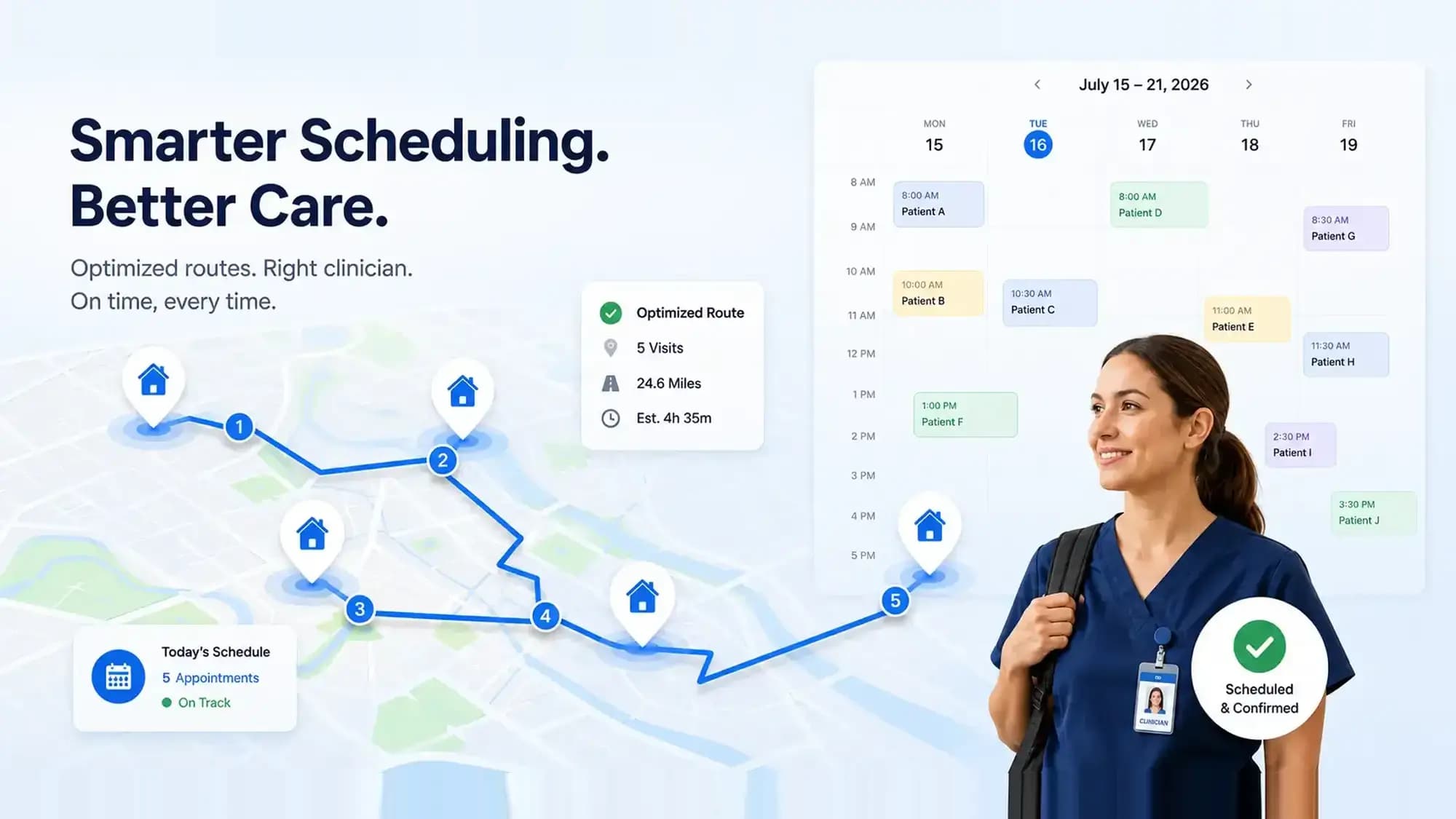
Home health clinicians work in the field. They're at patients' homes, not at desks. A coordination platform needs a mobile experience that works for a clinician who needs to update patient status, review visit instructions, or escalate a concern from a patient's living room. This is a different design requirement from a desktop Teams channel.
Audit trails
For compliance and quality purposes, home health agencies need to know who communicated what, when, and about which patient. A purpose-built system maintains that record automatically and ties it to the patient and episode. In Teams, reconstructing a communication timeline for a specific patient requires manually searching through channels, DMs, and meeting notes.

When to build vs. when to buy
I want to be honest here rather than just pitch custom development. There are legitimate SaaS options in the home health coordination space platforms that are purpose-built for this market and not generic communication tools. If one of those fits your operation, using it is a reasonable choice.
Custom development makes the most sense when:
- Your workflows are sufficiently specific that off-the-shelf solutions require significant workarounds. Home health operations vary more than most industries agency size, payer mix, care model, geographic spread, and state-specific requirements all shape what you actually need.
- You need EMR integration at a depth that existing platforms don't offer. Most coordination platforms have some level of EMR integration, but the depth varies significantly.
- You're building a differentiated product, not just running internal operations. If coordination software is core to your business model, custom development gives you the control that SaaS doesn't.
- You've tried the packaged options and they don't fit. This is actually the most common scenario we hear from agencies. They've tried one or two of the existing platforms and found that they either don't integrate deeply enough with their EMR, don't support their specific workflows, or have a UX that clinicians resist adopting.
The real cost of staying on generic tools
The case for purpose-built software is ultimately a cost argument, even if it doesn't immediately look like one.
Generic tools feel cheaper because the per-seat cost is low and the switch cost looks like zero. But the real cost is the time your clinicians and administrators spend on coordination friction every day, the readmissions that result from coordination failures, and the compounding cost of manual processes that should be automated.
An agency with 30 clinicians losing 12 minutes of coordination time per day is losing 6 hours of clinical capacity daily roughly equivalent to one full-time clinician's field time. At a burdened cost of even $40 per hour, that's $240 per day, or around $60,000 per year, in wasted clinical capacity. That math doesn't include admin time, readmissions, or the harder-to-quantify cost of care quality.
Purpose-built software isn't cheap to build. But the ROI calculation, when you do it honestly, almost always comes out in favor of solving the problem properly.
Ready to talk about your agency's coordination software? Whether you're evaluating options or already know you need something custom, a 30-minute conversation is the fastest way to figure out what makes sense for your specific situation.
Written by

Founder & CEO
Gaurang Ghinaiya is the Founder & CEO of Nexios Technologies. He is passionate about building innovative software solutions that drive business growth. With years of experience in technology leadership, he guides teams toward excellence.