SaaS MVP Development: The Scope, Stack, and Timeline That Actually Ship
Most MVP failures are scope failures. How to cut to one core workflow, pick a stack you will not regret, and ship in 12 weeks instead of 12 months.
Most MVP failures are not engineering failures; they are scope failures that engineering faithfully executed. The product that was supposed to validate demand in three months ships in eleven, with a feature set nobody prioritized ruthlessly enough to cut, onto a market that moved. This guide is the scoping, stack, and timeline discipline we apply when a SaaS MVP actually needs to ship.
Scope: one workflow, done end to end
The test for MVP scope is brutal and useful: what is the one workflow a user completes that makes them come back? Everything that is not that workflow is a later release. The cuts that save months, in the order teams resist them:
- Admin panels: your team can run SQL and internal scripts for the first fifty customers. A founder-facing admin UI is a month you spent on yourself.
- Settings and configurability: every option is a decision you refused to make. Ship opinions; add knobs when two paying customers demand different behavior.
- Integrations beyond the one that matters: most B2B products need exactly one integration to be credible (the calendar, the CRM, the EMR). Build that one; list the rest on the roadmap page.
- Billing sophistication: one plan, monthly, card required (or manual invoicing for enterprise pilots). Proration, seats, and usage tiers are post-revenue problems.
- Native mobile: responsive web unless the product is used standing up in the field. When mobile is genuinely core, that changes the whole plan, and the tradeoffs in our React Native vs Flutter comparison apply.
What does not get cut: authentication done properly, payments that charge real cards, and the data model underneath the core workflow. Those three are load-bearing; corners cut there are rewrites, not shortcuts.
Stack: boring, with two decisions taken seriously
MVP stack advice is mostly noise because the honest answer is "whatever your team ships fastest in." The defaults we deploy: a mainstream full-stack framework (Next.js or Laravel in our practice), Postgres, a managed host, and off-the-shelf auth and payments. No microservices, no Kubernetes, no event bus: a modular monolith deploys in one piece and refactors honestly later, per the seam-finding logic of our modernization guide, which is much easier when the monolith was built with boundaries in mind.
The two decisions that deserve real thought at MVP stage because they are expensive to change later:
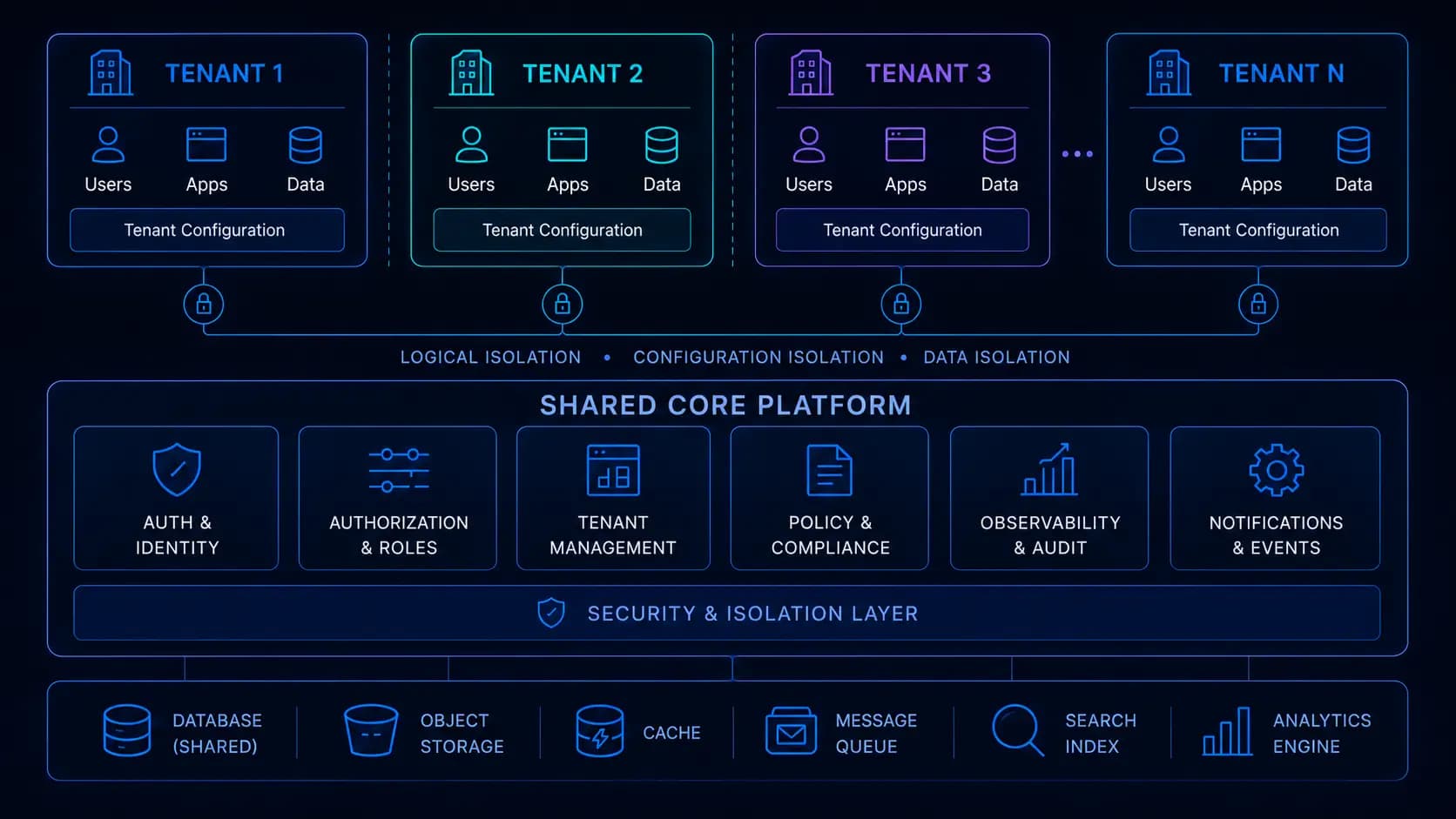
- Tenancy. If this is B2B, multi-tenancy is day-one architecture: a tenant column and row-level security cost almost nothing now and a re-architecture later. The full decision tree is in our multi-tenant SaaS architecture post.
- The core domain model. The five or six entities at the heart of the workflow. Whiteboard time here is the cheapest engineering you will ever buy; renaming and reshaping them under production data is the most expensive.
The 12-week shape
| Weeks | Focus | Exit criteria |
|---|---|---|
| 1-2 | Domain model, walking skeleton | Auth, deploy pipeline, and an empty version of the core workflow in production |
| 3-6 | The core workflow, for real | A design partner completes the workflow on real data |
| 7-9 | The credibility layer | Payments live, the one integration works, onboarding does not require a founder on a call |
| 10-11 | Hardening | Error tracking, backups, rate limits, the security basics a buyer's IT will ask about |
| 12 | Launch mechanics | Instrumentation of activation and the core workflow, so week 13 produces learning |
The pattern that makes this hold: production from week one, design partners using the product from week six, and a hard rule that new ideas go to the post-launch list unless they block the core workflow. Timeline slips are almost always scope re-entry, not engineering surprise, which is also why the engagement contract matters, per our contract checklist.
 Instrument for the decision the MVP exists to make
An MVP is an experiment, and the launch is the measurement, so define the metrics before writing code: activation (completed the core workflow once), retention on that workflow (came back and did it again), and willingness to pay. Analytics on those three events beats a dashboard of vanity metrics, and it is what makes the week-16 conversation ("build on, pivot, or stop") a decision instead of a feeling.
The teams that ship MVPs in twelve weeks are not faster engineers; they are more disciplined scope-cutters with a stack they do not fight. If you have a validated problem and need the product built at this cadence, our SaaS development team runs exactly this playbook, with dedicated teams for founders who want the capacity embedded longer term.
Written by

Founder & CEO
Gaurang Ghinaiya is the Founder & CEO of Nexios Technologies. He is passionate about building innovative software solutions that drive business growth. With years of experience in technology leadership, he guides teams toward excellence.