Luxury E-commerce Development: Where the Standard Playbook Fails
Luxury D2C breaks standard e-commerce assumptions: no urgency banners, price-on-request, appointment funnels, and a CRM relationship behind every order.
The standard e-commerce playbook is built on urgency: countdown timers, low-stock badges, exit popups, discount ladders. Luxury commerce inverts nearly all of it. The customer is not hunting a deal; they are evaluating whether your brand deserves them. Every pixel either reinforces that or breaks it. This guide covers where luxury D2C departs from the standard build, technically and structurally.
The conversion model is different
A mass-market store optimizes a single-session funnel. A luxury purchase is multi-session, often multi-channel: discover online, return three times, ask a question, buy in a video consultation or a boutique. The engineering consequences:
- Sessions are chapters, not funnels. Persistent, cross-device state (saved pieces, enquiry history) matters more than cart abandonment emails. The wishlist is a primary object, not a growth hack.
- Enquiry is a conversion. "Ask about this piece," "book an appointment," and "request a call" are tracked outcomes with owner assignment and response-time SLAs, not a contact form that emails an inbox.
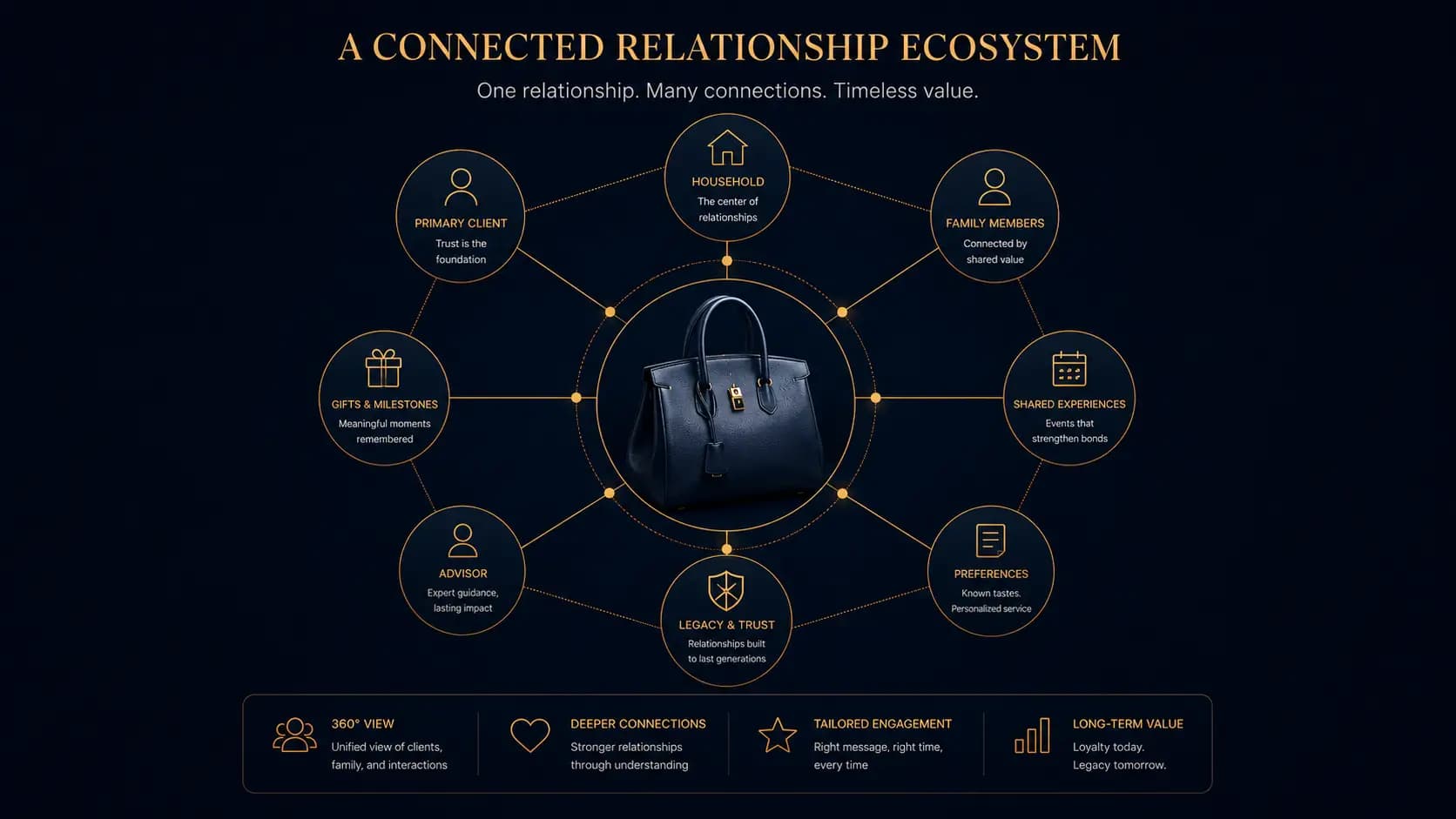
- The CRM relationship is behind every order. High-value clients expect to be known: their history, preferences, and prior conversations. The storefront needs a live seam to the clienteling system, the data model we cover in the luxury retail CRM data model and the reason generic CRMs fail this segment.
Patterns the standard playbook gets wrong here
| Standard pattern | Luxury replacement |
|---|---|
| Countdown timers, low-stock urgency | Quiet scarcity: "one available," waitlist with concierge follow-up |
| Discount popups and coupon fields | No public discounting; private client offers through the CRM |
| Visible price on everything | Price-on-request flows for top-tier pieces, feeding enquiries to a named advisor |
| One-page speed checkout | Considered checkout: appointment option, white-glove delivery choices, gift and engraving flows |
| Review widgets everywhere | Provenance and authenticity content: certificates, movement details, maker story |
Price-on-request deserves engineering respect: it is not hiding a number, it is a routing system. The enquiry must land with an owner, carry the piece and the client's history, and get a response inside a promised window. Done lazily it is a lead-loss machine.
Performance and craft are brand signals
A luxury site that stutters contradicts its own promise. The bar is higher precisely because the design is heavier: full-bleed imagery, video, 360-degree piece views. The techniques are standard (image pipelines, edge caching, careful animation budgets); the discipline is treating Core Web Vitals as brand metrics. This is also where headless architecture usually earns its cost in this segment: template storefronts fight you on both craft and speed, and the editorial content that drives luxury discovery wants a real CMS seam.
Imagery operations become real engineering at catalog scale: consistent lighting and framing across hundreds of pieces, zoom-grade resolution, formats per surface. We automated exactly this pipeline for a seller processing thousands of images monthly, documented in our image pipeline case study.
Inventory truth is harder in luxury
Luxury inventory is often unique pieces, not SKUs with depth: one reference in one condition with one set of papers. That breaks standard platform assumptions. Selling the same unique piece twice (site plus boutique plus marketplace) is a brand incident, so stock state needs real-time authority across channels, including reservation holds during enquiries and appointments. For watch and jewelry dealers specifically, consignment adds another layer: pieces you sell but do not own, with exposure accounting, the domain we cover in watch dealer inventory software.
Measurement without the growth-hack toolkit
Luxury still measures, it just measures different things: enquiry rate and response time, appointment bookings, waitlist conversions, returning-visitor depth on piece pages, and revenue per client relationship rather than per session. A/B testing continues to work, pointed at the considered journey (does the provenance module lift enquiries?) rather than urgency mechanics. Analytics discipline also protects the experience: consent-gated, invisible, no popups fighting the brand.
Luxury e-commerce is where our engineering and our luxury CRM practice meet: the storefront is the visible half of a clienteling system. If you are building or replatforming a luxury commerce experience, from the site through the CRM behind it, our e-commerce team has shipped this stack for exactly this segment.
Related service
Luxury Retail CRM Development
Purpose-built CRM systems for luxury watch and jewellery retailers: serial tracking, repair workflows, pre-owned inventory.
Written by

Founder & CEO
Gaurang Ghinaiya is the Founder & CEO of Nexios Technologies. He is passionate about building innovative software solutions that drive business growth. With years of experience in technology leadership, he guides teams toward excellence.