Why Salesforce Failed a Luxury Watch Retailer and What We Built Instead
A UK luxury watch and jewellery retailer tried every major CRM. None of them understood their business. Here is what we found when we replaced them with a purpose-built system, and what 30% year-on-year revenue growth actually looked like in practice.
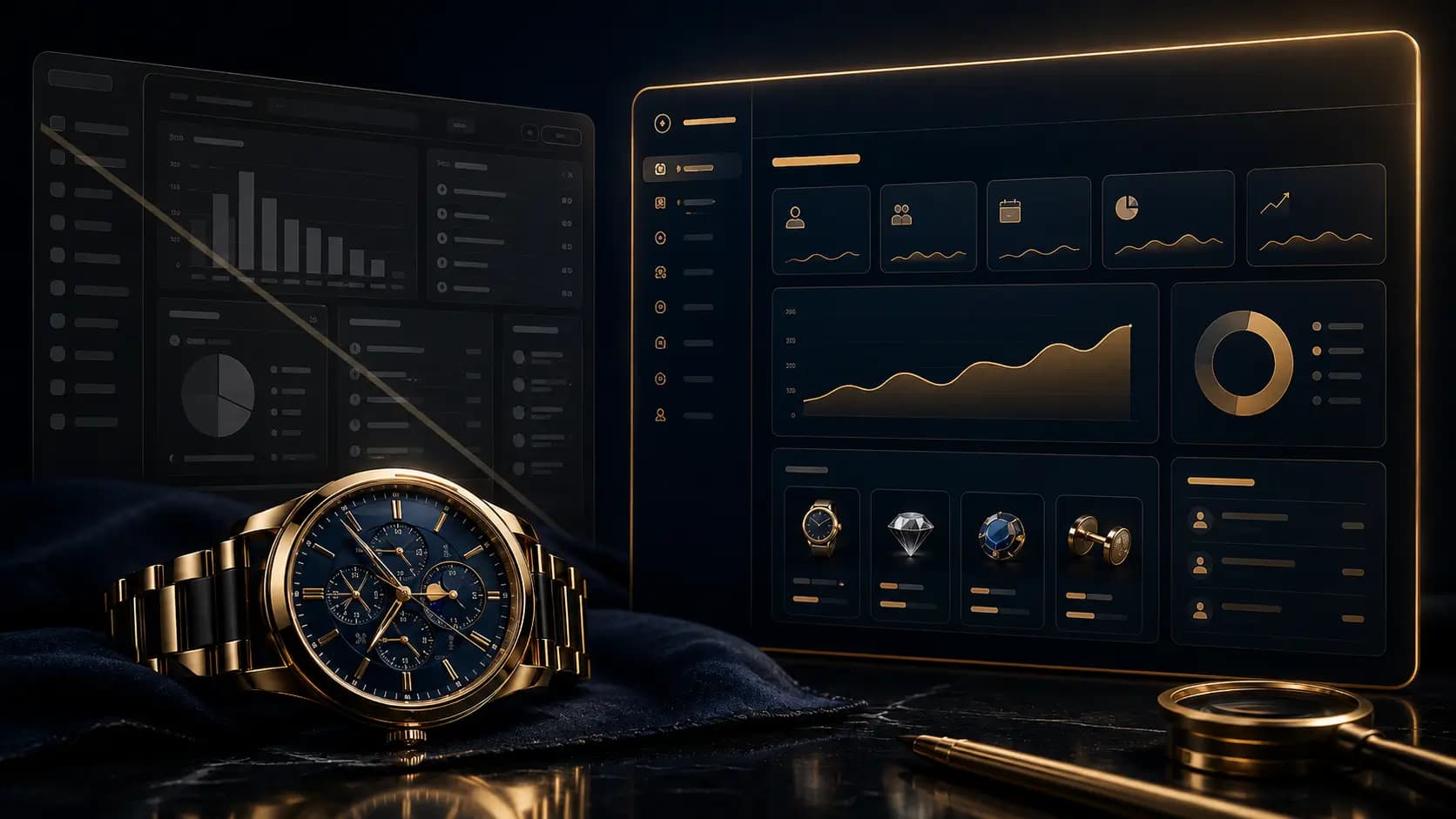
When a UK-based luxury watch and jewellery retailer came to us, they had already tried Salesforce, HubSpot, and two specialist retail platforms. All of them failed for the same reason: they were built for something else. Salesforce is built for B2B sales pipelines. HubSpot is built for inbound marketing and SaaS growth. Neither has a concept of a pre-owned Rolex with a specific serial number, a service history, a chain of custody, and a customer who wants to know exactly when their watch will be back from the watchmaker.
This is a story about building something that actually fits the problem, the specific metrics it produced, and why bespoke software almost always beats category software for businesses where the business model itself is the differentiator.
What generic CRMs cannot model
A luxury watch and jewellery retailer does not operate like a SaaS company or a B2B agency. The differences matter at the data model level:
- Inventory is not a product catalogue: A pre-owned Patek Philippe is not the same as another pre-owned Patek Philippe of the same model. Each piece has a serial number, a condition grade, a provenance history, and a price that reflects all three. No off-the-shelf inventory module handles this correctly without significant customisation.
- Repairs are not tickets: A repair workflow for a luxury watch involves intake, condition assessment, movement inspection, part sourcing, watchmaker time, quality check, and customer notification at multiple stages. A generic ticketing system can approximate this, but it cannot enforce the workflow or capture the right data at each stage.
- Sales attribution is complicated by the physical object: Did the sale close because of the sales associate who greeted the customer, the one who retrieved the watch from the safe, or the one who processed the payment? In a multi-staff boutique, commission attribution is a significant operational and morale issue. Generic CRMs track lead-to-close for software deals; they do not model a retail floor.
- The customer relationship spans years and multiple pieces: A customer who buys a watch in 2019, brings it in for a service in 2021, consigns a pre-owned piece in 2023, and enquires about a new arrival in 2025 is not a series of disconnected transactions. They are a relationship. The CRM needs to surface the full history instantly, without clicking through five different modules.

The system we built
We built on Laravel and MySQL. The choice was deliberate: the client needed something their own developers could maintain, extend, and understand without vendor lock-in. The system covered six core workflows:

Inventory with serial number tracking
Every piece in the system, new, pre-owned, or mint-condition, is tracked by its individual serial number. The record stores condition grade (assessed at intake), provenance history (previous owners if known), service history, and current status (in stock, out for service, sold, or consigned). When a sales associate pulls up a piece on the floor, they see its complete history. When a customer asks about the origin of a pre-owned piece, the answer is in the system.
Unified order management
In-store sales and online orders were previously in separate systems with no reconciliation. Stock availability on the website reflected what was in the system at the last manual update, which meant regularly overselling pieces that had already been sold in-store. The new system maintains a single inventory record, and any sale, regardless of channel, updates it in real time.
Repair workflow
The repair module tracks every job from intake to collection with stage-by-stage status, estimated completion dates, and automated SMS/email notifications to customers at key stages. Jobs can no longer fall through the cracks because they live in a system with explicit ownership and escalation rules. Before implementation, repair-related complaints were the most common category of customer service issue. After implementation, they were not in the top five.
Staff performance and commission
Every sale, service recommendation, and upsell is attributed to the staff member who initiated and closed it. Commission calculations that previously took days of manual spreadsheet work now run automatically at the end of each pay period. More importantly, the data surfaced that two staff members accounted for a disproportionate share of high-value closes, information that changed how management structured floor assignments and training.
Customer profiles
Each customer profile shows their full purchase history, brand and style preferences, active repairs, wish-listed pieces, and total lifetime value. High-value customers are flagged so any team member picking up a call or greeting a walk-in has the context they need without asking the customer to re-explain their relationship with the business.
Pre-owned intake
Buying pre-owned stock from customers or at auction is a significant part of the business. The intake module captures condition grading, market price benchmarks at time of purchase, provenance documentation, and the chain of custody from acquisition to sale. This data later feeds the provenance record that the selling associate can show to the next buyer.
The 30% figure
Thirty percent year-on-year revenue growth is the headline metric, but it is worth unpacking what actually drove it because "we got a new CRM" is not the correct causal story.
The unified inventory eliminated the overselling problem, which had been causing customer cancellations and reputational damage on a small number of high-value orders every month. Removing that friction had a direct revenue effect.
The customer profiles enabled targeted outreach when relevant pieces arrived in stock. When a pre-owned example of a watch on a customer's wishlist came in, the sales team knew to call that customer first. This converted at a rate the business had never measured before, because they had never been able to execute this motion consistently.
The repair workflow improvements reduced turnaround time and customer complaints. Customers who previously did not return after a repair experience now did. Repeat customer rate improved measurably.
Staff attribution data changed how top performers were recognised and retained. The business was not losing its best salespeople to other boutiques at the rate it had been.
None of these are "the CRM did it." What the CRM did was make these motions possible at the operational level. The business executed them.

Why bespoke software wins for businesses like this
The argument for off-the-shelf software is always cost and speed. Both are real. But the argument breaks down for businesses where the operational complexity is the business. A luxury watch retailer is not a business that runs on a standard model and needs software to support it. The way they buy, sell, service, and relate to customers is what differentiates them from a commodity retailer. Software that flattens those differences into generic categories costs less to buy and more to operate.
The total cost of ownership calculation looked very different after two years. The time spent maintaining manual workarounds, the revenue lost to operational failures, and the staff time consumed by reconciliation tasks that should not have existed, all of that has a cost that does not appear in a software licence comparison.
What this means if you are in a similar position
If you are running a business where the operating model is genuinely differentiated and you have found yourself customising generic software past the point of maintainability, or maintaining parallel systems to cover what the software cannot do, it is worth having a conversation about whether a purpose-built system makes financial sense.
For this client, the answer was clearly yes. The 30% YOY growth is the number they cite. But the cleaner operational picture, fewer fires, fewer manual processes, and fewer complaints, is what makes the day-to-day difference.
Related service
Luxury Retail CRM Development
Purpose-built CRM systems for luxury watch and jewellery retailers: serial tracking, repair workflows, pre-owned inventory.
Written by

Founder & CEO
Gaurang Ghinaiya is the Founder & CEO of Nexios Technologies. He is passionate about building innovative software solutions that drive business growth. With years of experience in technology leadership, he guides teams toward excellence.